
If you’ve ever been halfway through some projects, looked down at your tape measure, and thought, How long is a foot again? – you’re not alone. The foot is one of those units that everyone uses informally, but not very many people could define with a draft around Encyclopedia Britannica. You can see it at the hardware store when you’re looking at lumber, in airplane altitude readouts, and on the height listed on someone’s driver’s license. We’ve put together this guide to explain exactly how long is a foot, where the unit originated from, and how it compares with other measures of length before moving on to why the answer is more interesting than you might expect.
The Short Answer: How Long Is a Foot?
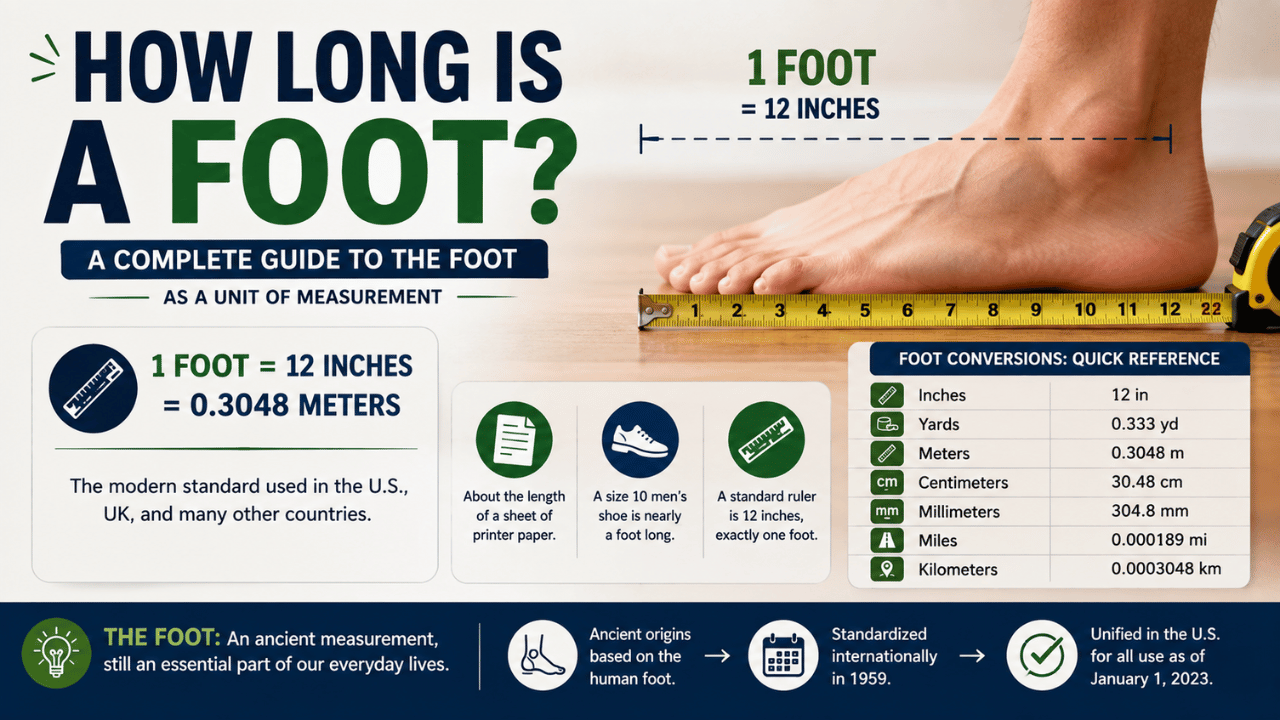
One foot is equal to exactly 12 inches in feet or 0.3048 meters. That’s the modern standard of measurement used in most everyday measurements today within the United States, United Kingdom, and a number of other countries that still use imperial or U.S. customary units. If you live by metric terminology, a foot converts to approximately 30.48 centimeters, or just above 304 mm.
To put that in perspective:
- A foot is about how long the sheet of printer paper is.
- A size 10 men’s shoe measures nearly a foot in length.
- The most common kitchen ruler is 12 in, precisely one foot.
So the next time someone or even our own kids ask how many inches in a foot, the simplest right answer is: 12 inches (Imperial measurements), equivalent to approximately 30 centimeters.
Where Did the Foot Come From?
The foot is one of the oldest units of measurement known to mankind, and its name is exactly what you think it sounds like: based on the length of the human foot. Ancient societies (think: Egyptians, Greeks and Romans) all measured foot lengths, but since there was no global standard (and no way to enforce one!), the length of a foot varied by region and era.
This mismatch is one of the reasons that historical “feet” don’t always correspond with the modern foot. A Roman foot or pes was about 11.6 modern inches long, while regional variations from across medieval Europe ranged anywhere between about 10 and 13 inches. However, as everyone was basically measuring against their own point of reference, trade and construction across regions could become quite messy, an issue which ultimately led to a push towards standardization.
The Standardization of the Modern Foot
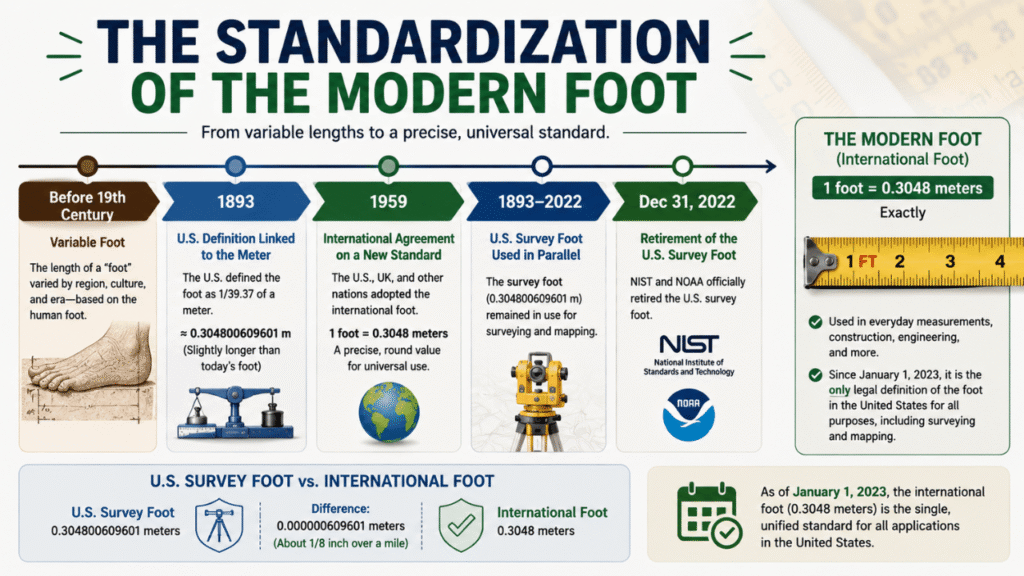
The version of the foot we use today was not completely codified until curiously recently. The foot was first defined by relation to the meter in 1893 in the United States, as one whole number divided by a metric equivalent: 39.37 inches = 1 meter. Thus the foot ended up being defined at around 0.304800609601 meters, a little longer than today’s foot, which was then called “the U.S. frais of the foot”.
In 1959, the US, UK, and other nations settled on a revised international standard that was nice and round: precisely 0.3048 meters per foot. It was dubbed the international foot,” and it is what practically everyone means to this day for day-to-day measurements, building, and engineering.
The U.S. survey foot and the international foot existed in parallel for decades because land surveying and mapping data stretching back to the 19th century was based on the old and slightly longer definition. However, that wasn’t a trivial task, and the U.S. survey foot remained in use for specialized applications long after 1959. It was not until December 31, 2022, that the U.S. survey foot was officially retired by the National Institute of Standards and Technology (NIST) and the National Oceanic and Atmospheric Administration (NOAA).
To date, January 1, 2023, the foot is defined as exactly 0.3048 meters for all purposes within the United States and thus remains its only legal definition everywhere, including surveying & mapping based on it. The distinction was slight, roughly one-eighth of an inch over the length of a mile, but for professionals who work with large distances and government data, standardizing on one definition reduced a source of long-running error.
Also Read: How Tall Is 60 Inches | How Long Is 3 Inches | Things That Are 7 Inches Long
Foot Conversions: Quick Reference
Once you convert it to the units you actually need, knowing how many inches a foot is makes navigating so much easier. Below is a quick reference table to the most common conversions.
| Unit | Equivalent to 1 Foot |
| Inches | 12 in |
| Yards | 0.333 yd |
| Meters | 0.3048 m |
| Centimeters | 30.48 cm |
| Millimeters | 304.8 mm |
| Miles | 0.000189 mi |
| Kilometers | 0.0003048 km |
If you work with measurements on the regular, a few of these are worth memorizing. In a yard, there are three feet; in a mile, 5,280 feet – two strategic shortcuts for times you’re converting distances without access to calculating machinery.
Feet vs. Meters: The Easy Way to Look at It
If your normal measurement system is metric and you’re trying to develop a feel for feet, these benchmarks are useful:
- 1 foot = 0.3 m (a bit less than a third of a meter)
- 3.28 feet = 1 meter
- 6 ft = 183cm (Common rough height reference for an adult)
- 100 feet = 30.5 meters
- One football field (100 yards) comprises just about 300 feet (91.4 meters).
A meter is slightly longer than three feet, so fast-and-dirty mental conversions typically use the rule of thumb “multiply feet by 0.3 to get meters” or “multiply meters by 3.3 to get feet.” Neither is precise, but both are good enough for everyday use.
Most Common Situations Where You’ll Need a Foot Length
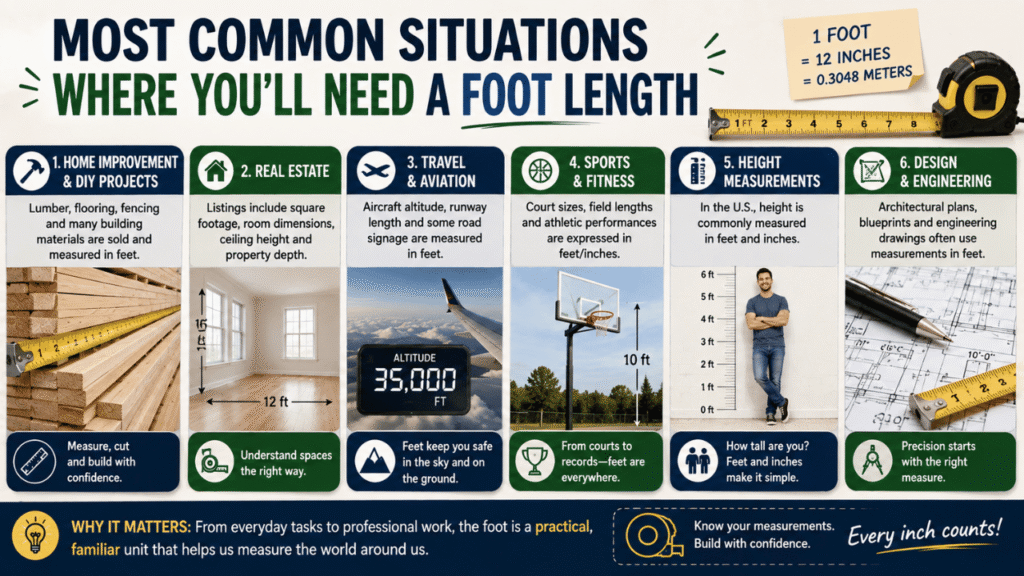
More useful than you think, knowing exactly how long is a foot?
- Lumber, flooring and fencing – items for home improvement and DIY projects are also virtually guaranteed to be sold and measured in feet.
- Real estate – Most listings in the U.S. contain square footage, ceiling height and dimensions of rooms.
- Travel and airline – altitude, runway length, and some road signage worldwide is in feet.
- So when they cite fitness and sports – the size of courts and fields, distances jumped by athletes, etc. Also expressed in feet/inches/ounces.
- Common height references – Feet and inches are the primary units of measure for how many people in the U.S. typically describe their own height instead of centimeters.
Why People Still Use the Foot
If one considers that most of the world uses the metric system, it stands to reason to wonder why on Earth the foot has survived at all. In the United States, miles remain the everyday unit for distance, as do feet (inches and yards are those of real estate design and aviation). Building codes, architectural plans, lumber sizes, and real estate listings are almost universally in feet. In fact, people often refer to ceiling heights or room dimensions and property depths in familiar terms – “10-foot ceilings” or a quarter-acre lot are expressions that most Americans instinctively have more sense of than they would with meters.
Aviation is another major holdout. The world still measures aircraft altitude in feet virtually everywhere, even countries that use the metric system for everyday life. Historically, this is largely a matter of simple convention and standardization – once feet-based altitude reporting became the worldwide norm, there was little motivation to change it since uniformity across international airspace is more critical than any argument of which unit is “more modern.”
And the basketball hoop, 10 feet high, and the 100-yard American football field are yet more illustrations of how deeply embedded the foot is in American sports, architecture, and everyday terminology, even for metric-minded people in most other areas of their life.
Conclusion
So, how long is a foot? Put another way, it was 12 inches (or 0.3048 meters) – an ancient unit that goes back thousands of years to when human feet were literally used to measure distance. The apparently haphazard foot began as an inconsistent, regional measure but was internationally harmonized in 1959, and by 2023 the US adopted a single unified definition of the foot for all purposes, including surveying. Be it framing a room, checking your height, or translating an altitude display on a flight, the foot still stands as among the most sensible and long-lasting units of everyday measurement.
FAQs on How Long Is A Foot
1. How long is a foot in inches?
A foot is exactly 12 inches.
2. How long is a foot in meters?
One foot is equal to 0.3048 meters, exact
3. How many feet are in a yard?
There are 3 feet in a yard.
4. How many feet are in a mile?
One mile is equivalent to 5,280 feet.
5. What was the U.S. survey foot replaced by?
The U.S. survey foot was officially retired on December 31, 2022, and replaced for all U.S application, including surveying and mapping, with the international foot (0.3048 meters exactly).