
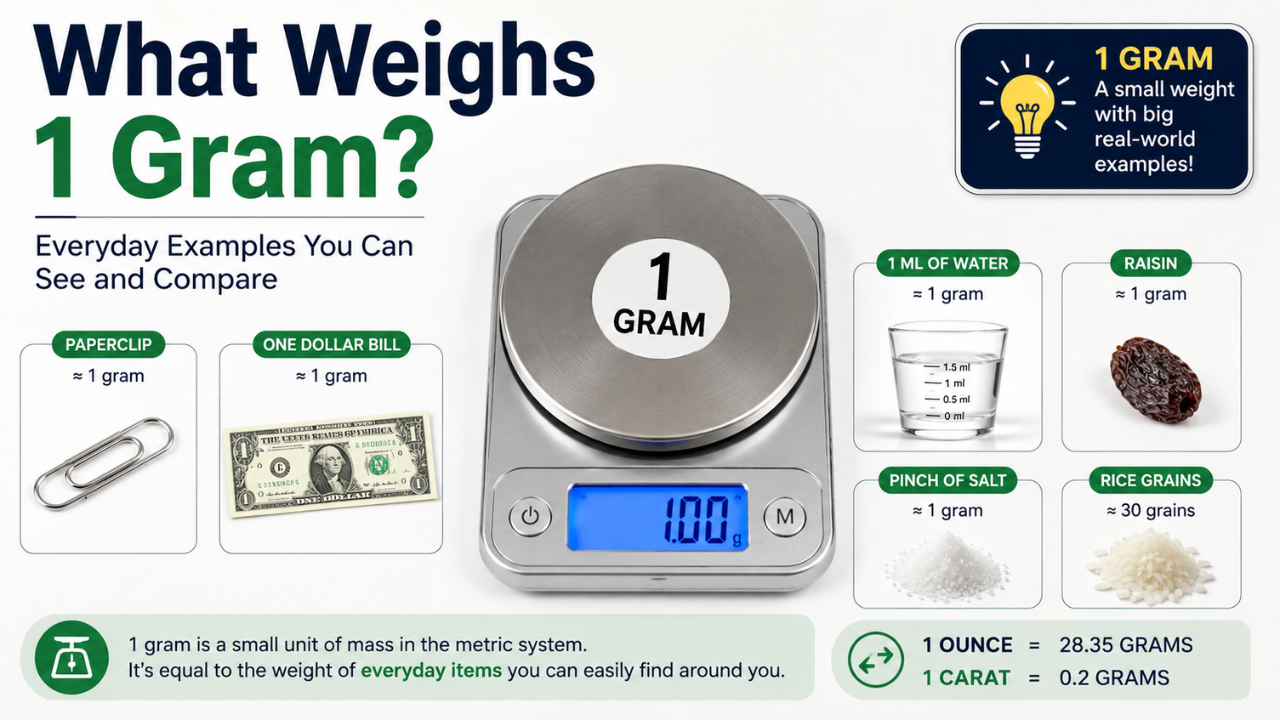
The gram is one of those units that sounds easy in theory, but unless you have something to compare it to in the real world, it’s honestly hard to get a sense of. It is far too wee to show up in most toilet scales, yet it constantly appears in cooking, medications and science. So, what does 1 gram actually equal in the real world? This guide addresses that question with recognizable items, a couple of specific inspirations, and answers to the most frequently asked questions regarding this small but surprisingly crucial unit.
Just How Small Is a Gram? Understanding What Weighs 1 Gram
A gram is a metric unit of mass equal to one thousandth of a kilogram. In more commonly understood units, that converts to about.035 ounces – a very trivial unit in the context of everything measured in pounds or conventional ounces. Before diving into specific substances, we first laid out the common reference unit of 1 gram in terms of other familiar units in the table below. For context, this weight is roughly 1,000 times less than a liter of water, which is an undetectable amount that wonít register on most adult humans.
Quick Conversion Table
| Measurement | Equivalent |
| 1 gram | 0.035 ounces |
| 1 gram | 0.00220 pounds |
| 1 gram | 1,000 milligrams |
| 1 gram | 0.001 kilograms |
| 1 gram | 1 milliliter of water (by volume equivalence) |
By itself, that last line would have been worth remembering; it provides one of the most straightforward methods to visualize this weight with a device that anyone has lying around.
11 Items From Everyday Life To Explain What Weighs 1 Gram?
You know, numbers do not stick unless they are associated with something real. Here follow the same, everyday household objects and references that lie around this weight, some precise docufictional examples, some more vague comparisons.
1. A US Dollar Bill
It doesn’t matter what denomination or paper stock it is; all standard US bills have virtually the same weight (almost 1 gram). It’s probably the most commonly stated comparison for this weight because nearly all of us have picked up paper money and can readily tell you how light it feels.
2. A Standard Paperclip
A classic go to comparison would be that since a standard metal paperclip weighs about a gram it is one of the oldest materials used in classrooms specifically for such measurements. The light, thin construction of this means you can almost feel the weight by simply holding one in your palm.
3. Five Carats of Gemstones
In gemology terms, one carat is precisely the weight of 0.2 grams, which means five carats worth of any gemstone equates to this amount. If you know anything about gemstones, chances are you’ve heard the term carats used before (and probably even know its relevance to grams as well).
4. A Single Raisin
Raisins, for example: an average raisin is roughly 1g in mass, a simple snackable reference for anyone visualising this weight in their kitchen. Given that raisins are small, equal in size with brilliant contrast, they make a surprisingly good visual comparison.
5. A Thumbtack or Push Pin
This is roughly the mass of a simple metal thumbtack, the kind you might use on corkboards or bulletin boards. The small size and lightweight metal make it a natural comparison for anyone with even a hint of experience handling office or craft supplies.
6. One Milliliter of Water
Since a density of 1 gram per milliliter is the definition of water; therefore, one milliliter of water weighs this exact amount. That’s about one-fifth of a teaspoon (for all the metric folks, 1/5 tsp = 1 ml and there are about 5 mls in a full teaspoon, therefore one of the most mathematically precise comparisons you are going to find).
7. Average Vitamin or Aspirin Tablet
All common tablets, including regular aspirin and several types of multivitamins, are in the vicinity of this weight depending on their composition and size. Anyone who has ever held a pill knows how well this actually feels like very little.
8. A Pinch of Salt
In much of home economics, a dash is informally understood to weigh about one-sixth of a teaspoon – this turns out to land quite near such weight. That’s a useful cooking reference when you’re trying to imagine how much is in, say, small ingredient quantities without weighing them out.
9. A Cotton Ball
According to Berend, a typical cotton ball weighs between 0.5 and 1g depending on how compact it is. The light and airy nature of cotton candy is also an easy visual cue that weight and size don’t always directly correlate.
10. A Single Potato Chip
One potato chip weighs approximately 1 to 2 grams on average, depending on size and thickness, making it relatively light in this measurement range. It seems, on the surface, to be an easily digestible comparison that most everyone can imagine.
11. About 30 Grains of Rice
If a single grain of rice weighs a fraction of a gram, then about 30 grains together yield approximately this total weight. An advantage of this is that it’s useful for anyone who wants to visualize this measurement as adding together smaller measurements.
What Is The Benefit of Knowing What Weighs 1 Gram
Even if the particular weight is too small to really measure in general lifting or carrying, there’s a practical reason why this measure matters across multiple fields; knowing what weighs 1 gram, and therefore how many grams an object contains or uses, comes up far more often than you might think.
Many, if not most, food recipes specify small ingredient measurements in grams (especially for spices, leavening agents, or flavoring extracts) because differences smaller than you can get on a typical kitchen scale could have significant effects on the final result.
Although a gram or two might not seem like a lot, many dosages for medications in medicine and pharmacology are measured in milligrams (1/1000 of the unit).
In jewelry and precious metals, as these materials are very valuable, grams or carats in the carat system are often used.
For instance, in science education, this weight is a frequent teaching reference specifically because quotidian classroom items, such as paperclips, give students a means to develop an intuitive basis for metric mass without requiring specialized instruments.
How To Calculate 1 Gram Without A Scale
If you do not have an accurate model scale, several mental heuristics will get you in the ballpark with this weight. Consider a dollar bill, or maybe even the average paper clip – two of the more widely accepted references you can lean on, given most people have access to such ubiquitous items.
Alternatively, you can think of it in water terms, as a millilitre weighs exactly this. If you’re familiar with small liquid measurements, an eyedropper filled partially to around one-fifth of a teaspoon is a fairly accurate visualization.
What Weighs 1 Gram: Comparing Solid, Liquid, and Loose Items
The answer to what weighs 1 gram might be the same for everybody, but since you experience weight in a very physical way with your body, an object of identical mass may not reflect that feeling of weight identically depending on its shape and density. This is especially clear when you compare what weighs 1 g among different materials.
Solid, regular objects like a paperclip or dollar bill are comfortably easy to gauge with their weight distributed uniformly over a small, consistent shape. You can pick one up, and right away you can feel how heavy they are.
Defining loose or granular objects (like a handful of salt or, say, several grains of rice) can be deceptively light-seeming or heavy-feeling depending on how you gather them because discrete loose materials do not take on the same fixed shape as a solid object does.
A milliliter of water is actually a totally different reference point because liquid weight and mass are governed far more by volume than by anything physical you could grab and hold in your hand.
For non-rigid or compressible items (like a cotton ball), the same apparent volume may have significantly different actual weight because of how tightly packed together all that material is, even if two cotton balls are approximately the same size visually!
These different examples help us see why some comparisons seem more intuitive than others even though every example above speaks to the same weight underneath.
Also Read: How Much Is 2 Ounces | 3 Meters | 7 cm
Conclusion
When you plug this micro unit into a couple of concrete anchors, a dollar bill, a paperclip, an individual raisin, the digit stops seeming arbitrary and begins to become real. Knowing what weighs 1 gram in real, physical life is shockingly useful when you’re cooking, skimming a nutrition label, buying jewelry, or just scratching an itch over how light this measurement really is.
FAQs About What Weighs 1 Gram
1. What is a simple example of what weighs 1 gram?
A US dollar bill or a standard paper clip weighs approximately 1 gram.
2. Does 1 milliliter of water weigh 1 gram?
Yes. Under standard conditions, 1 mL of water is equivalent to approximately 1 gram.
3. How much do the foods we eat normally weigh at 1 gram?
1 gram is the weight of a raisin, a pinch of salt, or roughly 30 grains of rice.
4. Why is it that science classes use 1 gram?
With everyday objects, it helps students become familiar with metric mass.
5. Is it possible to measure 1 gram without a scale?
Yes. A paper clip, a dollar bill, or 1 mL of water is a decent benchmark.