
If someone tells you that a wound is 7 cm, or if you’re looking for the dimensions of a product and see that they are 7 cm, the number alone seldom paints an accurate picture in your head. Centimeters are great for measuring and manufacturing, but don’t always easily convert to something your mind can automatically take in, especially if you’re used to thinking inches/feet instead of centimeters. This guide remedies that by relating this length to tangible objects, sports gear, and everyday items with which you already have a feel for, so the next time you see it on a label, report, or shopping page, it stops being an abstraction.
The Basics: What Does 7 cm Convert To?
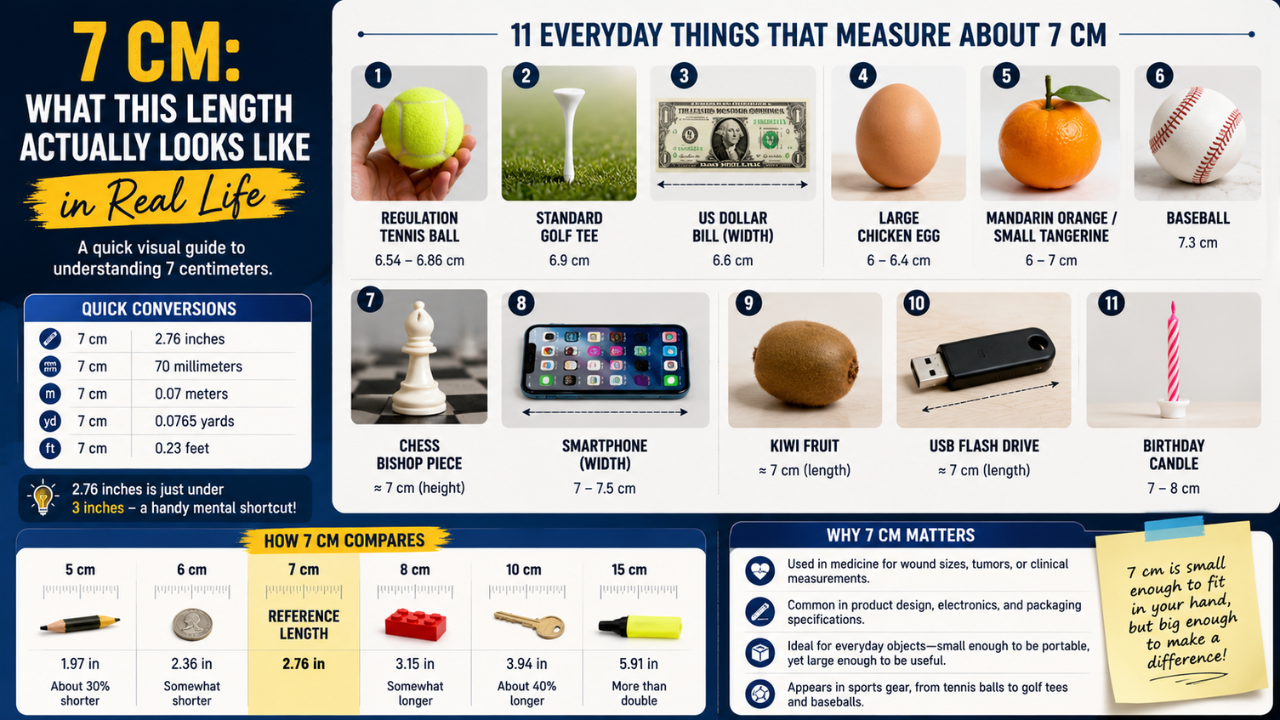
Seven centimeters is small to medium length; longer than your average coin but shorter than your typical pencil. It is around 2.76 inches in the imperial system. That’s 70 millimeters, or specifically exact in mm (and a handy reference for stroked specs when using finer metric increments).
Quick Conversion Table
| Measurement | Equivalent |
| 7 cm | 2.76 inches |
| 7 cm | 70 millimeters |
| 7 cm | 0.07 meters |
| 7 cm | 0.0765 yards |
| 7 cm | 0.23 feet |
Keep remembering that inch conversion because 2.76 inches rounds close to “just under 3 inches,” and this is a great mental shortcut if you are trying to do some estimates quickly.
11 Everyday Things That Measure About 7 cm
They rarely stick, especially numbers, unless related to something you know. Here are common items that end up being somewhere around this length, from accurate sporting equipment specifications to typical household objects.
1. A Regulation Tennis Ball
This is one of the closest matches to an official tennis ball in the real world, which has a diameter of between 6.54-6.86 cm. If you’ve ever played or watched tennis, then you will already have an instinctive feel of what this volume feels like in hand.
2. A Standard Golf Tee
Golf tees fit right in here: they almost all measure 6.9 centimeters long. In fact, golfers who have hit one into the ground before their tee shots have dealt with something almost this precise length a million times.
3. A US Dollar Bill’s Width
A dollar bill is longer than this, although it has a width of 6.6 centimeters, which is just below this number. After all, most people have touched paper currency at some point, so this size is an underutilized mental calibration for what it takes.
4. A Large Chicken Egg
It is fit between this mark usually, a regular chicken egg measures approximately 6 to 6.4 centimeters long. People who cook quite a lot, and handle eggs often in the kitchen, have a pretty intuitive sense of this size.
5. Mandarin Oranges or small tangerines
Most mandarin oranges and small tangerines approach this length with a diameter of about six to seven centimeters, though, so that’s one of the more relatable fruit comparisons. This is an especially intuitive reference due to how compact and easy it is to hold.
6. A Baseball
A full-sized baseball is about 7.3 centimeters in diameter, or just over this line. That size is physically intuitive if you’ve ever played catch, or even just held a baseball in your hand.
7. A Chess Bishop Piece
In standard tournament-grade chess sets, the bishop is typically about 7 centimetres tall, nestled between shorter pawns and taller king and queen pieces. You have a pretty good referential point for this specific piece if you are a chess player who has had to hold a full set of pieces at one time.
8. A Smartphone’s Width
Most current smartphones come in at around the 7 to 7.5-centimeter mark depending on models and screen size. This is one of the more readily accessible comparisons that can be made, likely because most people always have a phone on them anyway.
9. A Kiwi Fruit
A standard kiwi fruit, which you might be familiar with from your grocery store aisle, is about 7 centimetres long, providing a comparison for this size. You can easily envision and remember it, with its oval shape and fuzzy skin.
10. A Standard USB Flash Drive
The old-generation USB memory sticks, especially full-size ones, tend to be about this length from end to end. It’s an example from a routine, ordinary tech comparison everyone has used at one point.
11. A Birthday Candle
When unlit, your typical birthday candles clock in around 7 to 8 centimeters long. It’s a relatively ubiquitous and small object that almost everyone does have a fairly decent visual memory of via things like cakes/celebration.
Also Read: 3 Meters: What This Length Actually Looks Like in Real Life
The Width of 7 cm: Analysis of the leads
Adding this measurement next to a few shorter and longer lengths hopefully provides some context.
| Length | In Inches | How It Compares |
| 5 cm | 1.97 in | About 30% shorter |
| 6 cm | 2.36 in | Somewhat shorter |
| 7 cm | 2.76 in | Reference length |
| 8 cm | 3.15 in | Somewhat longer |
| 10 cm | 3.94 in | About 40% longer |
| 15 cm | 5.91 in | More than double |
How to Estimate 7cm with No Ruler
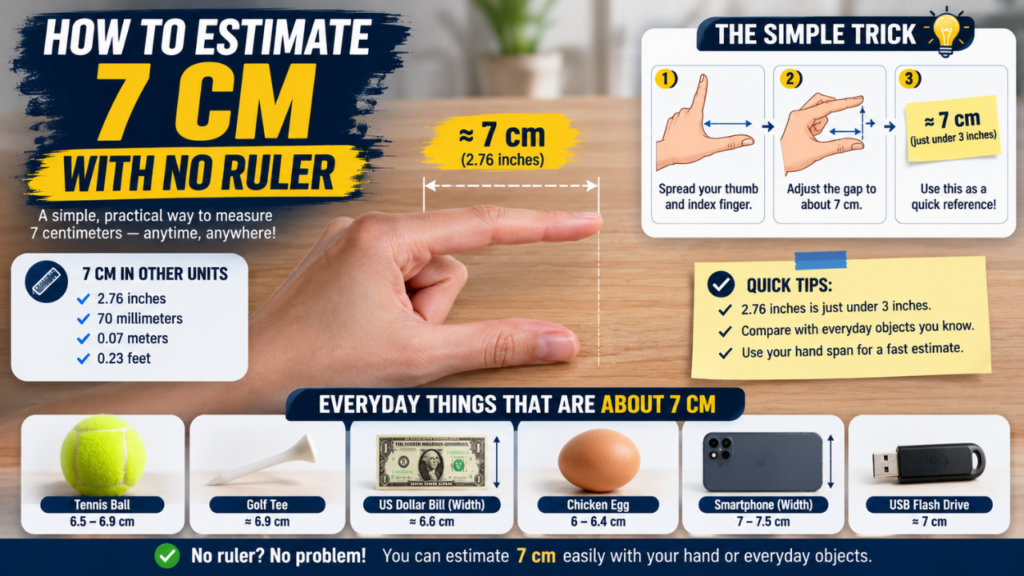
A couple of real-world references can give you a rough estimate of this length if you do not have measuring tools readily available. You had to know that number in advance if you planned your grasp of something: the typical adult hand, measured across the palm at its widest point – is about this figure, so an open palm is weirdly handy, a built-in reference.
An alternative is to use the currency guide. Because a dollar bill is slightly less than this limit in width, simply visualizing that same width plus a smidge will get you within a close range of the real number.
Smartphones offer a third option. Since most phones come close to this width, holding one sideways and imagining that distance should give a reasonable mental picture, especially for anyone who already has a robust knowledge of approximately how large his own phone is.
Why This Measurement Comes Up So Often
And that’s the practical reason why this particular length is common to many fields.
Thus, measurements on this scale are often quoted in medicine for the sizes of wounds, tumors, or other clinical observations that are not negligibly small and certainly not radially large by many diagnostic standards.
Since it is a comfortable size for something designed to be held or touched by hand, dimensions near this number appear repeatedly in electronics, packaging and small bits of hardware in manufacturing and product design.
For instance, many regulation sizes in sporting goods fall between a tennis and a baseball, and cluster precisely around this measurement, making it an intuitively relatable based reference point for fans or players who already have some tacit understanding of these objects.
Citrus and kiwis are very common examples of produce that fall in this general size range, which is why grocery comparisons often work so well as a label for visualizing this length (in regards to cooking and groceries).
In crafting and DIY projects, a few inches below that sig fig is often the length of multipurpose small tools, fasteners, or materials you cut or measure close to; it makes both convenience and compact project usages since the 2-inch size works when it’s relatively substantial but sub-3″ for cutting weight.
Contexts Where You’ll Typically See this Measurement
That length appears in a number of everyday and occupational contexts, often with little context beyond the observation.
This is the sort of figure patients find themselves stumbling over often when talking about their health, as medical reports and imaging results continually reference measurements in this general ballpark to describe the size of masses or growths: millimeters for the daily lives of most illnesses.
This specific dimension is often used in online shopping listings for products that fall into categories like jewelry, electronics accessories, or small home goods, as many smaller items are manufactured with this approximate size range in mind.
This is also a measurement you may see in some recipes and cooking instructions, especially for the size of vegetables or fruit when the pieces need to be uniformly sized for even cooking or when specifying how large portions of dough should be.
Many craft and sewing projects use pieces cut to this length, because it’s a usable size for buttons, ribbons, strips of fabric, and lots of other small elements in more meticulous handmade work.
The Changing Length of Perception depending on the context
A measurement feels different glued on something and how it observes. Being aware of those shifts creates an even sharper mental image.
A little versus a big object. This sort of dimension would feel sizable on something small like a coin or button but almost irrelevant on anything more considerable, such as a piece of furniture or wall, where the same length nearly vanishes within the scale of everything around it.
Compared with being measured in one dimension versus multiple ones. A flat length is not the same thing as a width or depth (or diameter) all at once, because an object of this size that was roughly cube-shaped would look way bulkier than one of the same length stretched out flat.
One that is held in hand and another from a distance. Close up, it’s easy to gauge things of that size accurately, but boxing in the same length just a few feet out becomes much harder to visually estimate, which is why physical reference objects work far more reliably than eyeballing a measurement.
Soft versus rigid materials. An example of this is a rigid piece (such as eg. a pen or small tool) versus a soft object (such as eg. a piece of ribbon or fabric); the first will hold its shape and remain easy to judge; the second has no specific form and will appear shorter or longer depending on how it is placed or draped.
Remembering these contextual nuances is a good reminder that one number is not usually the complete story by itself, and pairing it with a physical reference object continues to be one of the most successful ways to size something up accurately.
Also Read: How Much Is 2 Ounces? A Practical Guide With Real-Life Comparisons
Conclusion
Connect this to a few actual points of reference here, tennis balls, golf tees, mandarin oranges – and the number becomes less an abstraction and more something you can hold in your hand. Seven centimetres comes up again and again in the context of medicine, shopping, sport and things you might find around your home or office, which makes having a clear mental image of it very handy whether you’re reading a product description, involved with recipe preparation or simply trying to visualize a measurement mentioned somewhere on the internet.
Frequently Asked Questions (FAQs)
1. How many millimeters is 7 cm?
It is exactly 70 millimeters long (a centimeter is always has ten millimetres long).
2. What are everyday things about 7 cm long?
A normal tennis ball, a conventional golf tee, a mandarin orange and many smartphones at width land right around this size.
3. Is 7 cm medically a normal measure?
Yes, because it has been commonly used in medical reports to describe the size of masses or wounds (or other clinical observations) within the typical diagnostic size, around 4 cm.
4. How to estimate 7 cm without having access to a ruler?
You could also use the width between an open adult palm, the width of a dollar bill (then add a little less than the thickness of that bill) or, as some approximation, many standard smartphones.
5. What fruits are 7 cm in size?
Most commonly, small tangerine Mandarin oranges and kiwi fruits are close this length or diameter, so good food comparisons when you hit the grocery store.