
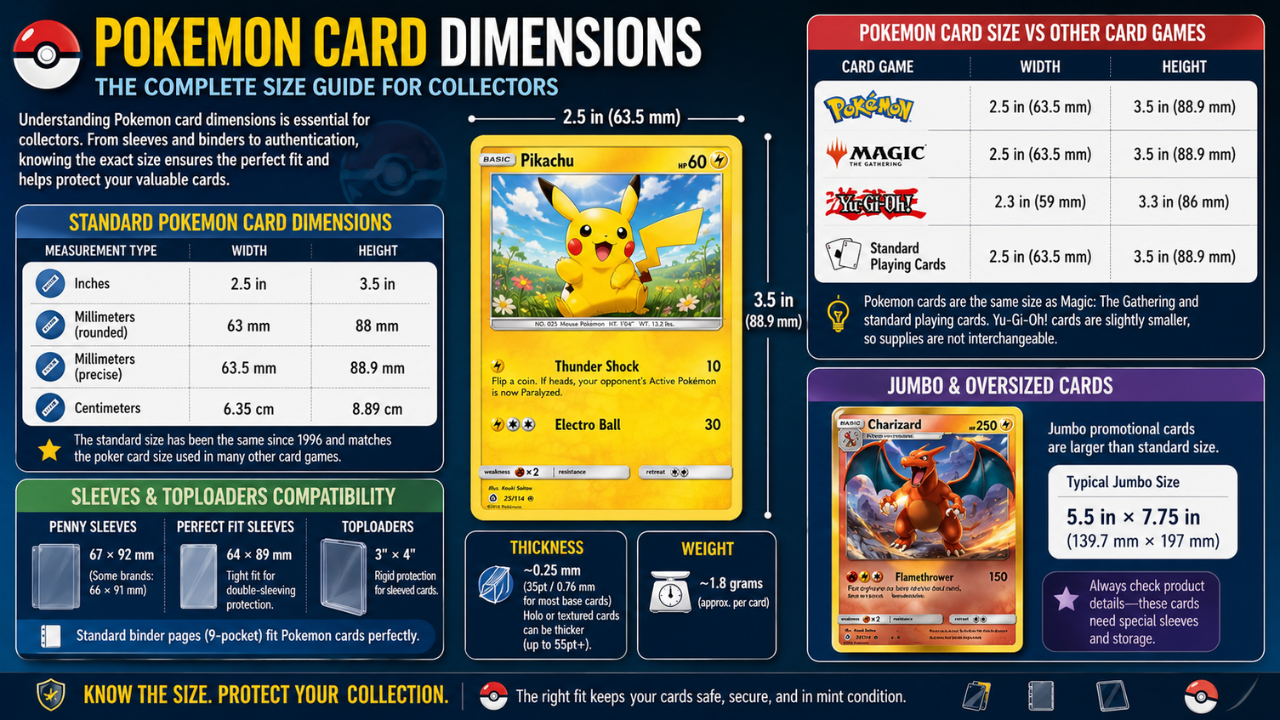
From sleeving a new pull from a booster pack to ordering yourself a binder online, or, if need be, figuring out if that rare card you just purchased is in fact real, understanding Pokemon card dimensions may just be one of the most useful bits of information any collector could have. This might seem like a small thing, but having that number incorrect means ill-fitting sleeves, binder pages that leave cards loose, or even worse, the inability to sniff out counterfeits.
This guide explains the breakdown of Pokemon card sizes to a standard card, how we compare when stacked against other trading card games, what sleeves and toploaders actually want you to have, and answers those most asked questions by collectors.
The Standard Pokemon Card Dimensions
Standard Pokemon card size is 2.5 inches wide by 3.5 inches tall. That works out to roughly 63.5mm by 88.9mm in metric, although many collectors and retailers round this off to a more convenient 63x88mm. The pack pull size is the same it has been since the trading card game was released in 1996, meaning a modern pack pull and an original Base Set card are the same size.
Quick Reference Table
| Measurement Type | Width | Height |
| Inches | 2.5 in | 3.5 in |
| Millimeters (rounded) | 63 mm | 88 mm |
| Millimeters (precise) | 63.5 mm | 88.9 mm |
| Centimeters | 6.35 cm | 8.89 cm |
These exact proportions just happen to be the standard so-called poker card size used in virtually every other card game, which is itself part of why so much of what’s on the market for storage products would actually fit your average gaming card rather than being fine-tuned to merely one trading card brand.
Pokemon Card Dimensions Beyond Width and Height: Thickness and Weight
Apart from the flat width and height, thickness is something useful to know if you are on shuffling duties in a real game environment. A regular card is about a quarter of a millimeter thick to 0.76 mm, usually measured by point counts in the hobby, with most base cards falling somewhere around 35pt (0.76mm). Specialty cards, like some Holo or textured releases, can be thicker, sometimes upwards of 55pt, which changes how they feel and shuffle compared to a standard card.
In terms of weight, an individual card usually weighs approximately 1.8 grams, a number that seldom matters in the daily life of trading cards (until it’s useful when weighing sealed packs or checking if a card might be one of those lighter counterfeits).
Pokemon Card Sizes in Relation to Other Trading Card Games
Perhaps one of the more informative things to know is how this measurement compares with other popular card games, since it directly impacts whether supply that exists from one collection can be used in another.
| Card Game | Width | Height |
| Pokemon | 2.5 in (63.5 mm) | 3.5 in (88.9 mm) |
| Magic: The Gathering | 2.5 in (63.5 mm) | 3.5 in (88.9 mm) |
| Yu-Gi-Oh! | 2.3 in (59 mm) | 3.3 in (86 mm) |
| Standard Playing Cards | 2.5 in (63.5 mm) | 3.5 in (88.9 mm) |
As the table demonstrates, Pokemon-sized cards match up evenly with both Magic: The Gathering and standard playing cards, which means that sleeves/binders/storage boxes meant for either one will usually work equally. Yu-Gi-Oh! cards, in contrast, run a bit short both ways – and that’s why you see dedicated Yu-Gi-Oh! The fact that sleeves and binder pages are separate things, and why mixing supplies between them with this game and out to Pokemon generally ends up yielding a looser fit that doesn’t stay in as well.
Also Read: 7 cm: What This Length Actually Looks Like in Real Life
Pokemon Card Dimensions: Sleeves And Toploaders Compatibility
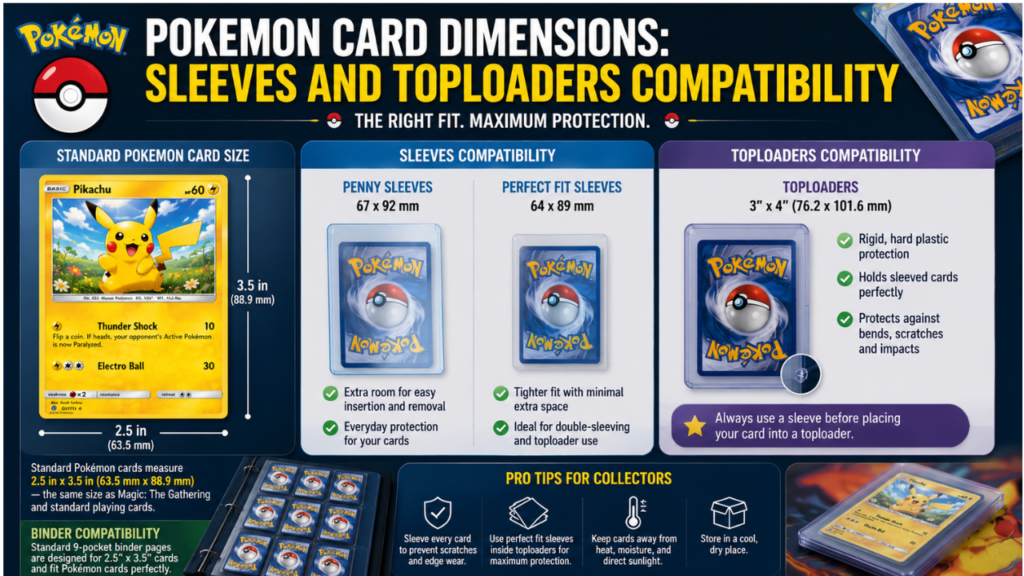
As these are probably the most frequently asked questions among collectors, it makes sense to go through them and break down exactly what supplies fit a standard card.
Penny sleeves are typically around 67 × 92 mm in size, leaving the card with enough room to slide in and out smoothly without too much bending or drag. Some manufacturers cite inch dimensions that are somewhat tighter at about 66 by 91 millimeters, which still fit nicely but take a bit of care to insert.
Perfect fit sleeves, a tighter alternative that many people who are serious about their tomat but do for double-sleeving setups, typically only measure around 64 by 89 millimeters (their upper border is basically the same as standard sleeve), which keeps the cards tight and without room to move inside a toploader.
As mentioned, toploaders are mostly 3 by 4 inches in size, making them rigid and crush-resistant protection once a card is already inside a sleeve. This is slightly larger than the actual raw card size, as it is designed to include a sleeve on top.
These fundamental measurements are the same from which binder pages for conventional trading cards are designed, so since most nine-pocket pages weren’t developed specifically for a smaller card format like Yu-Gi-Oh!, Pokemon cards generally slide right into them without any trouble.
Jumbo and Oversized Cards: An Exception to Standard Pokemon Card Dimensions
Standard is not the standard for every Pokemon card. Jumbo promotional cards, which are typically released with a giveaway at an event or as part of an outsize collectible, can be significantly larger than traditional trading card formats, weighing in somewhere around the 8 by 11-inch space. These giant cards are non-tournament legal and serve strictly as showpiece or collectible items, which means they necessitate a whole different class of storage options in the form of oversized sleeves or special jumbo card holders, rather than anything made for standard-size products.
Why Pokemon Card Dimensions Are Important when Authenticating Cards
Knowing these sizes matters when scouting fake pokemon cards; even if not as practical as storage. When cards are fake or bootleg they often vary a little in size, maybe 1mm or 2mm over their height width or thickness. A small size discrepancy isn’t always conclusive evidence of a counterfeit, but when paired with other indicators such as the wrong card stock, low print quality or strange coloring, a size mismatch is an important warning sign that something’s not right with the card.
This is also true of the card industry, with professional grading companies using super accurate millimeter measurements when determining centering. Graders operate on even more exact figures than this rough estimation because if a card is off by as little as one millimeter on one side, it can influence its final grade.
Pokemon Card Dimensions (Digital / Print)
Standard inch and millimeter figures are not enough for anyone designing custom card art, creating proxies, or printing on demand. 300 dpi is what we call standard print resolution, which equates to about 750 by 1050 pixels per card. With a little print bleed, around 0.125 inches on each side, this takes the full canvas size to about 825 by 1125 pixels. In web or lower-resolution examples, reducing to 72 DPI shrinks those ratios down to just under about 180 by 252 pixels.
The Reason Why this Standard has Not Changed
One should appreciate that this precise sizing has remained consistent for so long. Each mainstream release of the trading card game, which has been running since 1996 and crossed multiple generations of games and thousands of individual cards, has kept to the same basic sizes. This consistency is a big part of why the secondhand market, storage industry and grading companies can all operate on a single, predictable standard instead of having to constantly recalibrate for card sizes that seem to vary endlessly.
Pokemon Card Dimensions: How Different Collectors React to the Size
Different collectors interpret their thresholds across these measurements differently, and understanding the importance of each on varying use cases helps to clarify why so much resource is expended on what seems like numbers in isolation.
As a casual collector that mainly stores cards in binders for display purposes, the main purpose of knowing standard Pokemon card dimensions is avoiding the common problem of selling pages that your cards will not fit inside without more movement, leading to edge wear over time.
Tamer competitive players who shuffle decks constantly in fortuitous rags during tournament play, with a deck obtrude into the other hand as they tidy up between matches care about thickness and sleeve fit every bit approximately width and height per se, because cards that are too opaque or concave-sleeved hive down the buffer of shuffling so slowly that draw the ire from scrupulous and occasionally angry aficionados, arbiter mess which can be mistaken for fatally suspect deck or irregularity.
Vigorous investors and graders depend on millimeter-sized measurements when analyzing centering, as even a 1mm bender from standard proportions can alter a card’s final grade, not to mention impact its resale price.
Creators and designers working on fan art, proxies, or print-on-demand projects need these same fixed dimensions in pixels, translating inches and millimeters into resolutions that functionally work for printing or online display.
In all of these cases with those groups, the underlying numbers remain the same, but the incentive to give a damn about them and how precise they need to be changes significantly depending on what exactly someone is doing with their cards.
Also Read: 3 Meters: What This Length Actually Looks Like in Real Life
Conclusion
Pokemon card dimensions may seem like a trivial thing, but their information runs through the background of nearly every practical decision a collector needs to make, from which way should I sleeve these cards to how can I tell if that Charmander is legit? You know the drill: 2.5 by 3.5 inches, an industry-standard size that’s only been around for a few dozen decades, gives collectors peace of mind on their shopping expeditions (and unlimited reuse of supplies across multiple card games) and reveals just how standardized the hobby really is behind the scenes.
Frequently Asked Questions (FAQs)
1. Are Pokemon cards the same size as “Magic: The Gathering”?
Yes, both games share the same standard dimensions, which is why sleeves and binders made for one usually perform well for the other.
2. Do Yu-Gi-Oh! use the same size as the cards used for Pokemon cards?
No, Yu-Gi-Oh! cards size is slightly smaller at 2.3 x 3.3, which means Pokemon sleeves are slightly too big.
3. What sleeves fit standard Pokemon cards?
Regular penny sleeves 66 mm / 67mm w x 91/92mm h will usually snugly slide right in there.
4. Do jumbo Pokemon cards have the same size as regular ones?
No, the jumbo promotional cards are huge, usually 8 by 11 inches or so – and not tournament legal.
5. Are Japanese Pokemon cards in different sizes than English ones?
No, Japanese and English Pokemon cards are still the same standard size, so sleeves and storage products are interchangeable between both.