
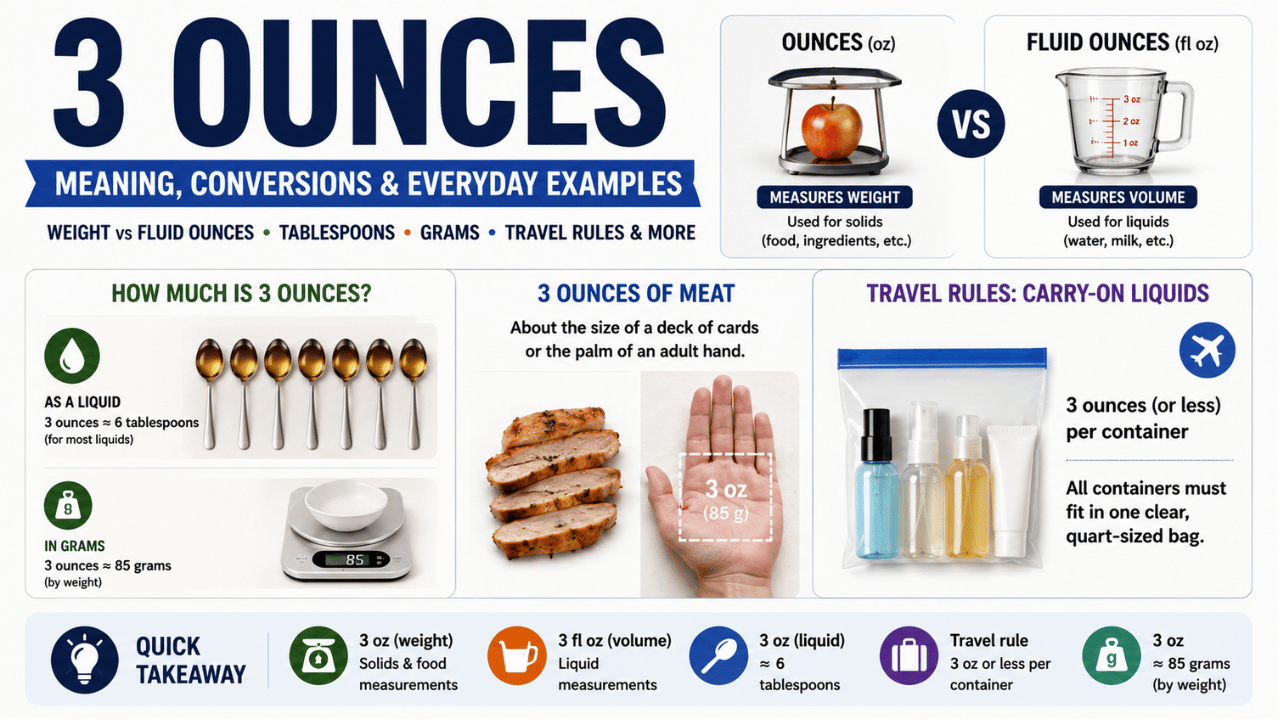
“3 ounces” sounds like the kind of measurement we kind of forget at first glance. A pound, a cup, something else that doesn’t sound especially important. But this same number appears all the time across everyday life, whether as the maximum size of liquids you can take through airport security, as the amount labelled on nutrition packaging, or as the amount left in a ball just short of completing your last knit project.
Once you become aware, 3 ounces is one of those quietly important measures that connect to travel, cooking, health, and even crafting. This post will pretty much tell you what 3 ounces really means in different contexts, how to exactly measure it, and why it keeps showing up again & again in rules as well as recipes.
How much is 3 ounces?
An ounce either measures weight or volume and varies with what you’re measuring. 3 oz = 85 g (weight). In terms of fluid volume, for example, the equivalent of 3 ounces is approximately 88.7 millilitres (22.5 pinch-sized units), or a little over a third of a cup. That difference is very meaningful when it comes to what you are measuring: a recipe calling for 3 ounces of flour indicates weight, but a bottle of shampoo marked 3 oz is nearly always volume.
With the word “ounce” being used for both weight and volume, confusion as to which is being referred to is common. If you have ever stood in a kitchen looking at a recipe wondering if 3 oz means weight or cup measurement, then you are not alone. The most cautious way would be actually to verify if the recipe or label mentions “fl oz” (fluid ounces, that is volume) or just “oz”, which generally, but not necessarily, refers to weight.
3 Ounces Conversion Table
| Unit | Equivalent to 3 Ounces |
| Grams | 85.05 g |
| Pounds | 0.1875 lb |
| Kilograms | 0.085 kg |
| Milligrams | 85,050 mg |
| Metric Tons | 0.000085 t |
The 3 Ounces Rule for Air Travel
One of the most popular ways to experience this measurement is through airport security, which limits the liquids you can carry on to 3 ounces or less. This is commonly known as the three-one-one rule, which states that liquids, gels, and aerosols must be in containers of 3 oz or less (and all fit inside one quart-sized clear bag).
It is little changed for years thanks in part to security worries stemming from a thwarted 2006 plot involving liquid explosives. Travelers prepping their toiletries must pour shampoo, toothpaste, lotion and other liquids into travel-sized vessels that fit in containers of less than 3 ounces. Any dedicated 3 ounces travel bottle is usually bought for this purpose, as it can be very difficult to guess the size that gets confiscated by airport security at the checkpoint.
If this is your first time really flying with just carry-on luggage, a decent tip is to go and buy yourself some semi-reusable 3-ounce bottles and label each as you fill them up so they are not overfilled. TSA officers do check container sizes, not just how full they are, so even big bottles that have less than the permitted amount could be an issue if the volume is larger than 3 oz.
Also Read: How Much Is 2 Ounces | What Weighs 1 Gram
3 ounces in Cooking and Nutrition
3 ounces a surprisingly common kitchen serving size, especially of meat, poultry and fish. Nutritionists often compare a serving of protein to the size of a deck of playing cards, which conveniently equals 3 ounces once cooked. This makes it a nice, simple mental hack for anyone trying to manage portion sizes without getting out the kitchen scales every meal.
Cooked meat reduces in weight during cooking, so if you have raw chicken or beef to start with, it generally needs to weigh about 4oz raw to produce 3 oz of cooked meat at the end. It is important to note that it shrinks during cooking due to the loss of moisture, and this is important if you are tracking calories or macros.
Nutrition labels cite 3 oz for meat and seafood because it is a recommended, common serving size as per health guidance. If you are working on eating less mindlessly, figuring out what 3-ounce of protein looks like on your plate is a skill worth learning, and far less challenging than attempting to memorize the gram size every time.
Common Objects that Weigh Three Ounces
One way to estimate what 3 oz weighs is by comparing it to things that you know the weight of if you do not have a kitchen scale around.
Here are some common examples:
| Everyday Object | Approximate Weight |
| Deck of playing cards | About 3 oz |
| Travel-size bar of soap | Around 3 oz |
| Smartphone (many models) | About 3 oz |
| Small flashlight | Around 3 oz |
| Pack of sticky notes | Roughly 3 oz |
Measuring 3 ounces without a scale
Since not everyone possesses a kitchen scale, this is how you can estimate 3 ounces without any special tools:
- Deck of Cards Trick: A piece of cooked meat about the size and thickness of a deck of cards weighs roughly 3 ounces.
- The palm method: For most adults, a piece of meat about the size of your palm (not including fingers) is around 3-ounce.
- Liquid measuring cups: Since 3-ounce of liquid is very nearly 3/8 of a cup, you can pour one reasonably accurately from a standard fraction-marked measuring cup.
- A kitchen scale: If you are keen for the most accurate results most especially when baking, a digital scale set to ounces or grams will always trump visual estimation.
These hacks are pretty cool for home cooking, but if you are on a diet and/or making something that requires real precision as opposed to eyeballing the amount, it probably makes sense to use a scale instead.
3 Ounces in Everyday Products
Apart from travel and food, 3 ounce crops up in all sorts of everyday products. That is why a lot of skincare and beauty brands have 3-ounce bottles to sell as their travel size product, because it is created with the airline liquid requirements in mind. Candle makers often sell sample-sized 3oz candles, enabling a new fragrance to be tried out without committing to a full jar of candle. Even tiny packages of things like nuts or dried fruit are sold in 3-ounce portions so the consumer can easily tally their available calories.
At this point, this size has basically carved out a niche in product development: just small enough that people call it “travel friendly” and “sample sized,” but big enough to be functional instead of the standard marketing gimmick.
What does 3 ounces look like?
Some more food comparisons can help you visualize 3 ounces:
| Food | Approximate 3-Ounce Portion |
| Grilled chicken | Deck-of-cards size |
| Cooked fish | Palm-sized fillet |
| Steak | Small palm-sized piece |
| Shrimp | 10-12 medium shrimp |
| Cheese | About 6 thin slices |
| Deli meat | 5-6 slices |
Even without using measuring equipment, these examples should still help you make rough estimates of serving sizes.
Common Conversion Mistakes to Avoid
Easily one of the most common errors is mistaking fluid ounces for ounces by weight. A lot of the reason these two get confused is that water has a fortuitous relationship in which 1 fluid ounce is very nearly equal to 1 ounce by weight. But this isn’t true for other substances. For this, 3 ounce of feathers occupy way more volume than 3 ounces of honey, for instance, since density varies a lot between materials.
A similar mistake is interpreting “3 ounces” on a nutrition label in the same way when comparing different foods. A 3 oz portion of chicken breast will look completely different on a plate than a 3 oz piece of cheese or nuts, as varied foods have different densities and shapes. Do not assume there is one size-fits-all serving; check the actual serving description.
Also Read: 2 Inch Guide | 3 Meters | 7 cm
Conclusion
Three ounces is a trivial amount, but in making practical decisions, packing a carry-on bag, portioning dinner, or grabbing something novel at the store, it often pops up. The difference between weight and volume, a couple of simple visual arithmetic tricks for estimating it instantly, combined with having a cheat sheet for the simplest conversions, will make this apparently insignificant unit of measure much less troublesome by the next time that pops up.
Frequently Asked Questions
1. How many tbsp are there in 3 ounce?
3 fl ounces or roughly about 6 teaspoons for liquids.
2. Why is there a 3 ounces carry-on liquid limit?
This is similar to restrictions on carrying liquids aboard aircraft, where airport security rules limit the quantity of liquid held in carry-on baggage.
3. How much is 3 ounces of meat?
It’s approximately the size of a deck of cards or a palm.
4. Can you get multiple 3 oz containers for a flight?
Yes, as long as each container is 3 ounces or less and they all fit in a single quart-sized clear bag.
5. How do you convert 3 oz to gm?
3 ounces is nearly equivalent to 85 grams.