
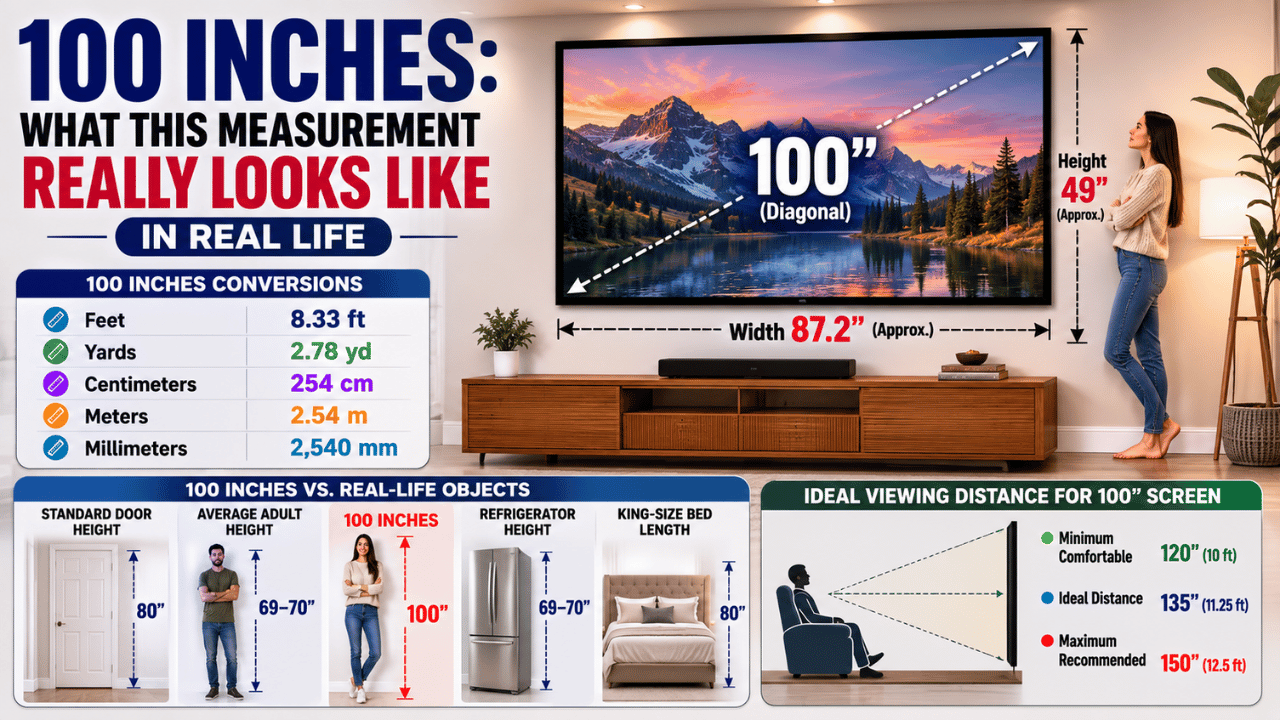
A number in itself is difficult to imagine; 100 inches is perhaps the perfect example. It’s not a measurement most of us interact with daily, so when it does appear–be it as a measurement for a TV on the box, in a listing from Shade Store, or as the horizontal size of your home cinema projector screen- it can be hard to fathom exactly how much you’re going to get. In this article, we’ll demystify just how large 100 inches is, what other measurements it equates to, and where in the world you’re most likely to encounter this value.
What Does 100 Inches Mean, in Fact?
An inch is one of the twelve bits that ultimately make a foot, and 100 inches means you have one hundred of those things placed end-to-end. To put that in a context we might grasp more easily, 100-inch is just over 8ft tall, about the height of a single-story room with enough space to get a little headroom. That seems like a big number, but in the context of 40 days it’s not really much: days there are long enough to make an impression.
Due to the fact that inches are used in the United States for anything from TV screens to furniture measurements, 100 inches comes up more than you would think in categories such as electronics, home decor, and construction.
100 Inches Conversion Table
A quick conversion table for translating 100 inches into a unit you’re more familiar with
| Unit | Equivalent to 100 Inches |
| Feet | 8.33 feet |
| Yards | 2.78 yards |
| Centimeters | 254 centimeters |
| Meters | 2.54 meters |
| Millimeters | 2,540 millimeters |
In this example, 100-inch comes in just above eight feet tall – taller than most standard doorways and around the height of a small single-story ceiling.
Where Are You Most Likely to See 100 Inches
Television and Projector Screens
100 inches is one of the things we encounter more often in home entertainment. TV and projector screens are not measured literally by width or height but rather diagonally, from one corner of the screen to that of an opposing corner instead. Relative to the distance, a large display, say 100-inch, is from a cinema-style setup but usually can hardly sit horizontally in a medium living area unless in a home theater room.
Using the standard widescreen 16:9 aspect ratio that most modern TVs and projectors use, a typical 100-inch screen is about 87 inches wide x 49 inches high.
| Screen Size (Diagonal) | Approximate Width | Approximate Height |
| 65 inches | 56.7 inches | 31.9 inches |
| 75 inches | 65.4 inches | 36.8 inches |
| 85 inches | 74.1 inches | 41.7 inches |
| 100 inches | 87.2 inches | 49 inches |
| 120 inches | 104.6 inches | 58.8 inches |
Because of just how large a 100-inch screen actually is, it’s rarely found as part of a conventional flat-panel screen; the cost and practicality of manufacturing and shipping a feature such as this in that size make it disproportionately expensive and impossible for many households.
Curtains and Window Treatments
In home accessories, curtain lengths are routinely available in inch increments, and 100-inch is often an available length for extra-long or floor-to-ceiling window coverings. Curtains are available in common lengths such as 63, 84, or 96 inches, but that doesn’t prevent a 100 inches curtain from appearing much longer than this typical length of curtains and hence maybe intended to be used on rooms which boast exceptionally tall windows or for style shake-or-toss or name-for-everyone-seen algae glam.
Fabric and Textile Measurements
Fabric is frequently sold by the yard, but total lengths are sometimes given in inches for smaller or custom orders. If we consider that a 100-inch length of fabric is just over 2.7 yards in length, this is already quite considerable for any home sewing or upholstery project.
Furniture and Room Dimensions
Random bigger furniture however (sectional sofas, dining tables, bookshelves) are occasionally posted with a total length near to 100 inches. At 100-inch, this sectional sofa is a sizeable offering; great for sprawling living rooms but not so well-suited to more compact apartments.
Also Read: 2 Inch Guide | 7 cm | 3 Meters | 3 Ounces
100 Inches vs. Common Household References
An often simple way to understand what a measurement is, is comparing with things you already know. The following is a visual reference table with concise information.
| Comparison | Approximate Measurement |
| Standard interior door height | 80 inches |
| Average adult male height | 69-70 inches |
| Refrigerator height (standard) | 66-70 inches |
| 100 inches | 100 inches |
| Small single-story ceiling height | 96-108 inches |
| King-size bed length | 80 inches |
From this table it is easy to see that 100-inch is taller than a typical adult, taller than most interior door frames and close to the upper limits of what you’d find in a low end single story home’s ceiling height.
Measuring 100 inches without a Long Tape Measure
Not everyone has a measuring tape that stretches 100-inch in one go.
A common 25-foot tape measure. Given that most tape measures we come across when doing home improvement projects go well past 100 inches, this was the easiest and most accurate option to use.
Combine shorter measurements. If the only tape measure or ruler you have access to is much shorter, simply measure in segments and add up the totals, being sure to closely note each stopping point to prevent mistakes.
Use a laser measuring tool. Described below are some of the tools that have become significantly cheaper in recent years thanks to advances in technology; a laser distance measurer, which measures distances over 100-inch accurately and displays results as inches, then feet.
Count tiles (or other objects you already know). If you have information on some size of floor tiles (or another repeating object in the room), you can create a distance slightly less than 100-inch.
Why Precision Matters at This Scale
Half an inch is not a disaster for smaller measurements. But when you get to this level, even the tiniest measuring inaccuracies can accumulate, a problem that pops up with more significant investments like home theater projector screens or custom furniture – everything has to be precise if you’re standing at 100 inches! If you are ordering a 100-inch screen for a room that’s really a couple of inches less in distance from comfortable viewing, it could be a case of an overload or discomfort instead of being immersed, which most people want.
In the context of projector screens, professionals often advocate for a recommended minimum viewing distance of approximately 1.2 to 1.5 times the diagonal screen size. This means for a size like 100-inch, you would generally want to sit between 120 and 150 inches away from the seating area, which is about 10 to 12.5 feet!
Quick Reference: Viewing Distance for a 100 Inches Screen
| Recommended Distance Type | Approximate Distance |
| Minimum comfortable distance | 120 inches (10 feet) |
| Ideal comfortable distance | 135 inches (11.25 feet) |
| Maximum recommended distance | 150 inches (12.5 feet) |
Before committing to a huge screen, you should always bear this range in mind so as not to be disappointed by the realization that your room simply is not big enough to make the most of a 100-inch.
How Big is Too Big for 100 Inches in a Room?
One of the most standard questions people ask when they’re considering buying something at this scale. How well 100 inches is sized in a room, or how overwhelming it may feel depends largely on the size of the room and the seating distance. This big of a screen in a small bedroom or apartment living room might be too much also, as you may have to sit uncomfortably far back. But in a dedicated home theater room, media room, or an expansive open-concept living area, 100-inch can create a jaw-dropping cinema-like experience without overwhelming the environment.
Also Read: What Weighs 1 Gram | How Much Is 2 Ounces
Conclusion
100 inches seems like an arbitrary number at first, but then you convert that to feet and compare it with stuff you know, and look at where it is commonly found in consumer goods, it all becomes much easier to visualize. When shopping for a projector screen, floor-length curtains or an over-sized sectional, knowing precisely what 100-inch looks like allows you to be more decisive and educated rather than taking the gamble with just a number.
Frequently Asked Questions
1. How many feet is 100 inches?
One hundred inches is around 8.33 feet, just over eight feet.
2. Is the 100 inches too big for your regular living room?
It depends on the room size. For cramped areas, 100 inches may look gargantuan but larger rooms and dedicated home theater spaces can more than hold a screen or furniture of this size.
3. How many yards is 100 inches?
This number is very helpful to know as many fabrics or textile-related materials may be sold by the yard, and you will want to convert inches into yards sometimes.
4. How wide is a 100-inch TV?
A 100-inch 16:9 screen measures about 87.2 inches by just shy of 49 inches.
5. What is the 100-inch used for?
It’s used for projector screens, large televisions, curtains, furniture, and room dimensions quite often.