
Whether you are establishing a backyard home court, confirming if your local gym can fit a regulation game, or just want to know how much the court shrinks between singles and doubles, familiarizing yourself with badminton court dimensions should occur before you draw any lines. There are even specific measurement rules in the sport, and getting them wrong can invalidate everything from the serve strategy to whether a shot counts as in or out.
Please note that this guide summarises the specifications of an official court size, specifications for a net, clear service areas and space requirements within which to construct or use a court – based on foreknowledge from the Badminton World Federation.
The Official Badminton Court Dimensions
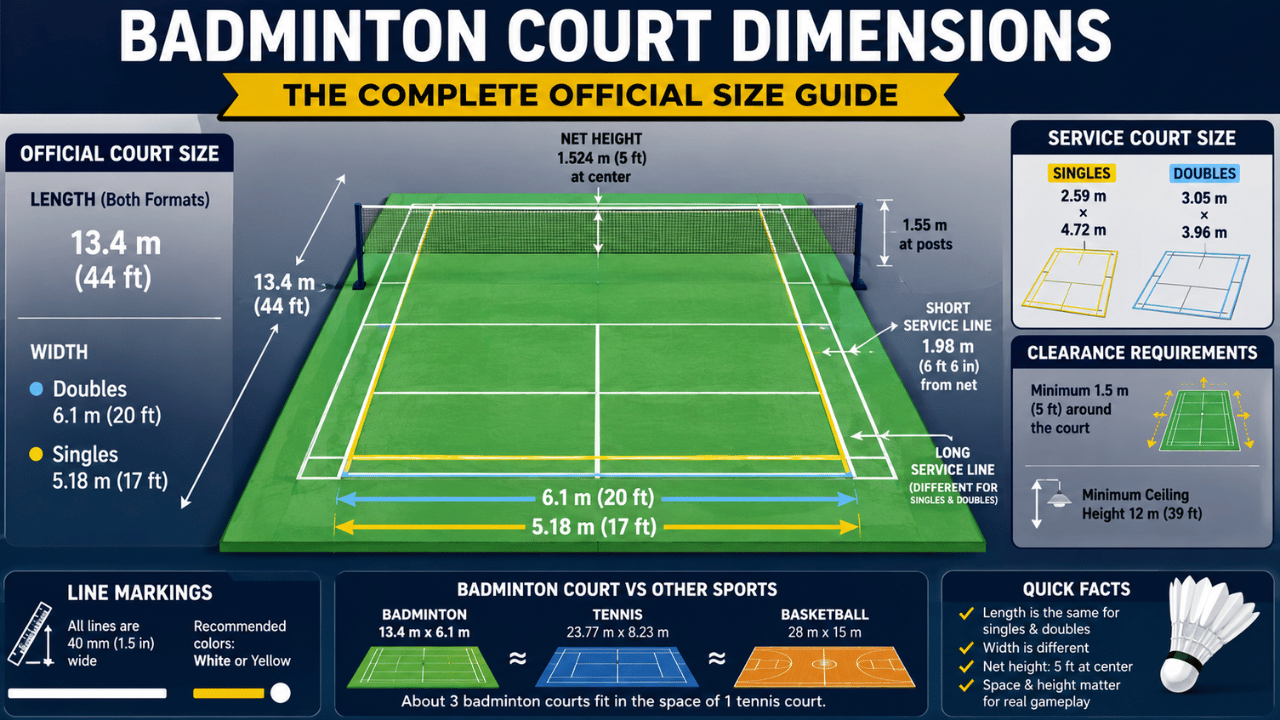
But the length of a regulation court remains at 13.4 meters (44 feet) no matter if you are playing singles or doubles, according to the Badminton World Federation. This is where it actually becomes a difference between the two formats – the width. A doubles court is 6.1 meters (20 ft.) across, but a singles court shrinks to just 5.18 meters (17 ft), shrinking by about 1.5 feet on each side.
Quick Reference Table for Badminton Court Dimensions
| Measurement | Doubles | Singles |
| Length | 13.4 m (44 ft) | 13.4 m (44 ft) |
| Width | 6.1 m (20 ft) | 5.18 m (17 ft) |
| Total Area | 81.74 m² (880 sq ft) | 69.41 m² (747 sq ft) |
| Short Service Line | 1.98 m (6 ft 6 in) from net | 1.98 m (6 ft 6 in) from net |
The consistency of the length in each format is one of the more surprising aspects of badminton court dimensions for new players, where most assume singles and doubles courts differ every way but width.
Net Height and Placement: The Badminton Court Dimensions
The net extends vertically over the center of the court, running sideline to sideline. It’s 1.524 meters, or 5 feet high at its center, while the posts on both ends are a touch taller at 1.55 m. That subtle change creates a bit of an indentation in the center of the net one that’s designed rather than accidental, because it impacts how shots fly across the top of the net during quick exchanges at close range.
By comparison, a badminton net is much taller than the center point of either a volleyball or tennis net – and this is part of why tournament badminton’s shots are typically arched more sharply than those in other racket sports (or non-racket net sports).
Service Lines and Court Markings
Since the boundaries for serving are different than those used in a live rally, court markings have a huge impact on how badminton is actually played.
The short service line is 6 feet 6 inches (1.98m) from the net on both sides of the court. Any serve that does not clear this line is considered a fault, and it must be cleared regardless of the singles or doubles nature of the match.
It is, however, a different story for the long service line, which functions differently depending on the format. In singles, this line is the outer boundary for back on the court, so you can serve the full length of the court. By contrast, the long service line in doubles is located approximately 0.76 m (2 ft 6 in) in from the back boundary, resulting in a shorter serve area, but rallies are still played to full-length boundaries with regulatory dimensions.
The center line divides the service area into left and right, assisting in determining, for players and officials alike – whether a serve landed in the correct diagonal service box.
Format also alters the covers. For singles play, the court is narrower as it utilizes the inner sidelines; doubles play uses the outer sidelines to open up the entire 20-foot width for longer rallies and wider coverage.
Service Court Breakdown
| Format | Service Court Size |
| Singles | 2.59 m × 4.72 m |
| Doubles | 3.05 m × 3.96 m |
Such a difference reflects the divergent strategic requirements of the two formats. And singles service courts are narrower but longer, encouraging deep and precise serves – doubles service courts are wider and shorter instead, since teams have to cover a lot more lateral ground when pounding away at the net.
Also Read: Monster Can Dimensions | Pokemon Card Dimensions
The Space Outside the Base-Lines
While a regulation court is necessary, there are other essentials required to make up a proper badminton setup. Official courts also need a large clearance space around the court itself, always at least 1.5 meter on every side (usually even more for top level international competition). As important as the ceiling height is since high, looping clears are a staple of competitive play. International guidelines suggest no ceiling clearance of less than 12 meters (39 feet) to avoid contravening the path a shuttlecock follows.
If you are building a badminton court for recreational purposes, the dimensions do not matter that strictly but having some feet of space between each side along with enough ceiling height make a better experience playing.
Badminton Court Dimensions in Comparison to other Sports Courts
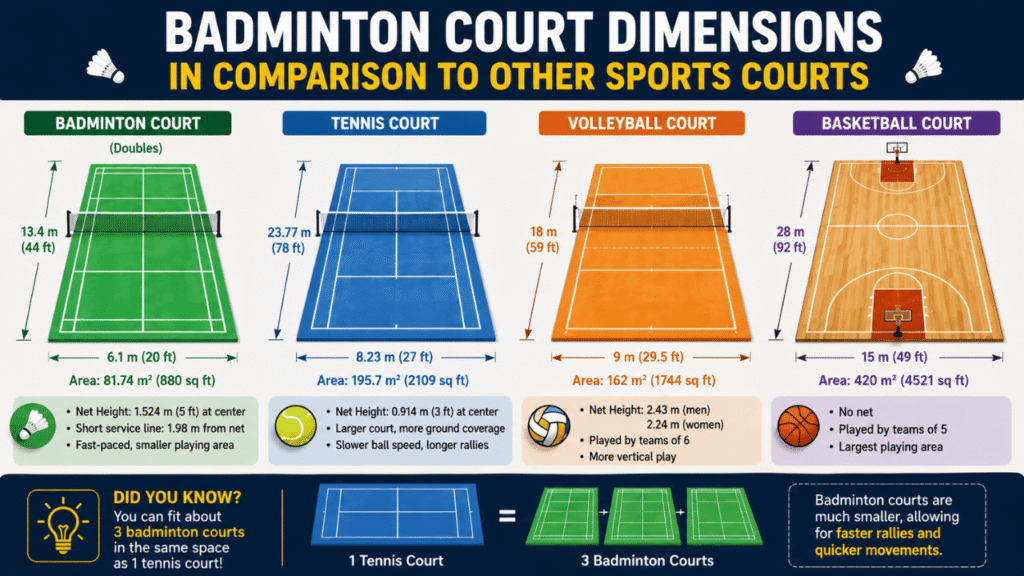
To give a better perspective of size, badminton’s dimensions alongside other more commonly known sporting courts. In fact, a badminton court can fit approximately three of them side by side on the same surface area, demonstrating just how much smaller and compact badminton’s actual playing area is compared to an equivalent-sized tennis court. Larger in area, but, for the most part, only horizontally. Otherwise, badminton’s net is much taller than a tennis net at mid-court, a factor that affects how sharply shuttlecocks curve compared to the level flight of a tennis ball.
Line Markings and Surface Requirements
The width of all lines indicating the side or back boundary on a court, including sidelines and service lines, as well as the tram lines in most cases, must be 40 millimeters (1.5 inches), while white and yellow are the recommended colors for maximum visibility on a color surface. Most venues designed for competition employ sprung wooden flooring or synthetic mats created to minimize the joint impact brought on by the repeated fast directional changes and jumping shots required of the sport.
How Badminton Court Dimensions Have Remained Unchanged
Unlike some sports whose official measurements have shifted over the decades, badminton court dimensions have barely changed since the Badminton World Federation began formalizing rules. This matters for a sport that ranges from backyard casual matches to the Olympic Games, with many meaningful levels of play in between, because it means that even the basic court a beginner plays and practices on has exactly the same fundamental core measurements as what is used at the highest level of professional competition.
And that consistency makes life easier for both facility managers and equipment manufacturers. Since the core numbers, 44 feet by 17 or 20 feet depending on format, do not vary by country and governing body under BWF, a court built to measure in one country plays just like one built anywhere else on the planet. When it comes to portable, semi-permanent court setups, which are increasingly used for multi-use gyms and community centers, these courts are also set to the same standardised badminton court size, allowing a single flooring system that can be changed from one sport to another without completely separate infrastructure.
So for home or recreational installations, this consistency also provides a useful reference point even if you can’t have a full regulation-size court because of space issues. Even slightly scaling back while maintaining the same width-to-length ratio provides a far truer-to-life experience than any speculation on unique proportions starting blind.
Also Read: 7 cm | What Weighs 1 Gram | 3 Meters
Conclusion
Key numbers for understanding badminton court dimensions are as follows: 44 feet long (same length for both formats), 20 feet wide (doubles) and 17 feet wide (singles); a net height of 5 feet at the center. Incorporate the other service line dimensions for singles and doubles, a minimum amount of clearance space around each side of the net, as well as overhead clearance height requirements; then you have everything to determine or prepare an official playing surface court. These measurements are essential for how the sport is actually played, whether you’re constructing your own home setup or simply wanting to comprehend what’s going on when viewing a game.
FAQs about Badminton Court Dimensions
1. What is the difference between single badminton court sizes and doubles?
At the net, singles courts are 44 feet long like doubles but narrow down to 5.18 meters (17 feet) wide by using two inner sidelines instead of two outer ones.
2. How high is a badminton net?
The net is 1.524 meters (5 feet) tall in the middle and marginally higher at 1.55 meters at the posts on either edge of it.
3. How much area around a court is required to satisfy the standard badminton court dimensions?
It’s advisable to leave at least 1.5 meters of space in all four directions, and if it’s a football competition, also a ceiling height of at least more than 12 meters.
4. Is a badminton court smaller than a tennis court?
In comparison, a badminton court is much more compact, with about three badminton courts fitting in approximately the same space as one tennis court.
5. What do the official lines on a badminton court consist of and how wide are they?
Lines on the court are 40 millimeters wide and usually painted in white or yellow so that they clearly stand out from the playing surface.