
From preparing a home for family member, to creating an inviting accessible renovation or even just trying to figure out what to expect (and how much space you’ve got) when shopping for mobility equipment: knowing the standard wheelchair size is critical. The accuracy of these numbers impacts everything, from the clearance at a doorway to how relaxed someone is sitting in the chair for hours. This guide will walk you through each key measurement related to standard wheelchair dimensions, discuss how these measurements impact access planning, and feature reference tables so that you’ll never again be hunting for numbers when a question arises.
Why Standard Wheelchair Size Matters
Wheelchairs are not a truly universal product, but the majority of manufacturers would shape a design around some widely understood ranges for measurement – this is basically what people mean by standard wheelchair size. There are two main reasons why these figures matter. One, these help people and caregivers select an appropriate chair that really fits the user, ill-fitting chairs can cause pressure sores like beds, poor posture, and increase low-grade mobility over time. Second, standard wheelchair dimensions immediately impact accessibility in homes, businesses, and public locations, as all doorways, hallways, and turning spaces need to fit these measurements to be truly functional.
The average wheelchair size is not something that only the actual users of a wheelchair need to understand. These measurements include significant features like wheelchair turning clearance, distance between grab bars, etc. Architects, contractors, caregivers, and facility managers use these measurements as a basis for designing spaces that meet accessibility needs while also fulfilling real-life everyday utility.
Overall Standard Wheelchair Size Measurements
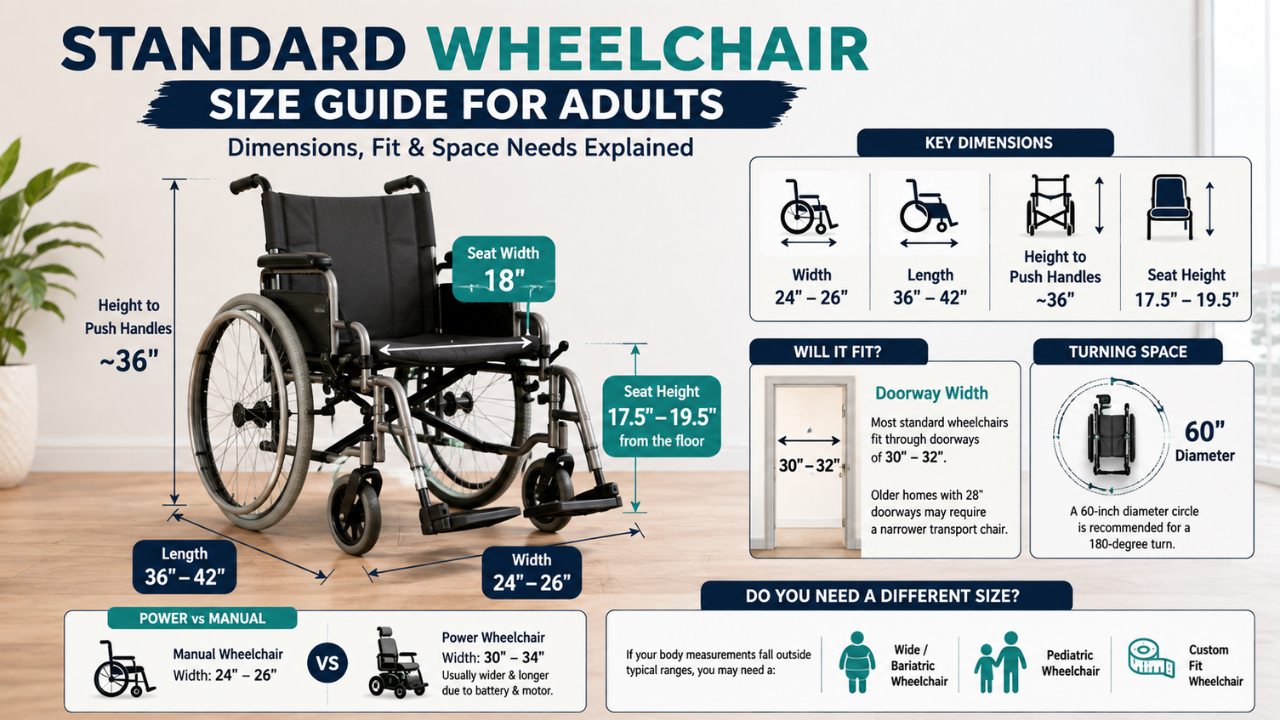
With respect to the issue of what wheelchair size is considered average, most individuals are actually referring to the entire footprint of a wheelchair (i.e., overall width, length, and height) as opposed to merely the seat. This is a rundown of the most often cited numbers.
| Measurement | Standard Range |
| Overall width | 24-26 inches |
| Overall length | 36-42 inches |
| Overall height (to push handles) | 36 inches |
| Seat height from floor | 17.5-19.5 inches |
| Folded width (for transport) | 12-13 inches |
These are for an adult-sized, manual, self-propelled wheelchair – the type that most people have in their mind’s eye when they think about what a standard wheelchair would look like. (We’ll get to some of the specifics further down regarding the differences in specialty power wheelchairs and more standard models.)
Seat Dimensions Within Standard Wheelchair Size
Individual fit truly comes into play above and beyond the overall footprint of the chair with the seat. Even with a traditional wheelchair size, the size of the seat varies according to your body and comfort.
| Seat Measurement | Common Range | Most Typical |
| Seat width | 16-20 inches | 18 inches |
| Seat depth | 16-20 inches | 18 inches |
| Backrest height | 16-20+ inches | 16-18 inches |
| Armrest height | Around 30 inches from floor | – |
When it comes to finding the right fit, seat width is arguably the most important measurement relative to standard wheelchair size – after all, this directly impacts hip support and prolonged comfort. Small-framed users who weigh under 150 pounds typically benefit from a 16-inch seat width, whereas an 18-inch seat width is viewed as the most versatile option for average adult weights of between 150 and 250 pounds.
Also Read: Stairs Dimensions | iPhone Wallpaper Size | Monster Can Dimensions
Seat Width and Body Measurements
A really constructive way for understanding standard wheelchair dimensions is for people to relate it directly to their own body measurements. The general approach to having a wheelchair fit properly is:
Seat width should correspond to hip-to-hip width plus one to two inches of comfortable space.
Example: if the distance from your butt to back of your knee is 17 inches, then you want about a 15 inch depth to avoid pressure behind the knee.
Seat height should match the measurement from the back of the knee to the rest of the foot ensuring that feet lightly embrace the footrests – without dangling and voluntarily pulled up.
If the body measurements of a user are far outside those associated with serviceable wheelchair sizes: for example, if they happen to be an adult at the top end of plus size or younger than the typical passenger, recommendations typically include custom or specialty chairs rather than STIHL intervals.
Standard Wheelchair Size by Category
Not every wheelchair is exactly dimensioned within the same range. Manufacturers usually provide a few width categories to allow for greater adaptability to various body types, all of which would still generally be classified within the overall standard wheelchair size range.
| Category | Seat Width | Best Suited For |
| Narrow | 16 inches | Smaller-framed adults or teens |
| Standard | 18 inches | Average adult body types |
| Wide | 20 inches | Larger-framed adults |
| Extra wide / bariatric | 22 inches or more | Plus-sized adults, higher weight capacity needs |
This tiered system enables most users to get a reasonably close fit without purchasing a fully custom chair, allowing prices to remain lower while still accommodating the majority of body types within the population-stated standard wheelchair size.
Doorway and Hallway Clearance
The average size of standard wheelchair is very important when planning accessible spaces, because doorways and hallways should have enough space for a wheelchair to be able to pass through comfortably.
| Space | Minimum Recommended Clearance |
| Doorway width | 32 inches (clear opening) |
| Hallway width | 36 inches |
| Turning radius (180-degree turn) | 60-inch diameter circle |
On average, a standard wheelchair is about 25-inches wide in the sitting position, and there’s usually a few extra inches of space to fit through a doorway that measures somewhere between 30-32″ with at least an inch on either side of clearance. If you live in an older home, though, it may have doorways as narrow as 28″ which could require using a smaller transport chair instead. This is a very common accessibility problem that homeowners face, especially when it has to do with an older building that was not originally designed to accommodate using a standard wheelchair size.
Standard Manual Wheelchair Size vs Power Wheelchairs
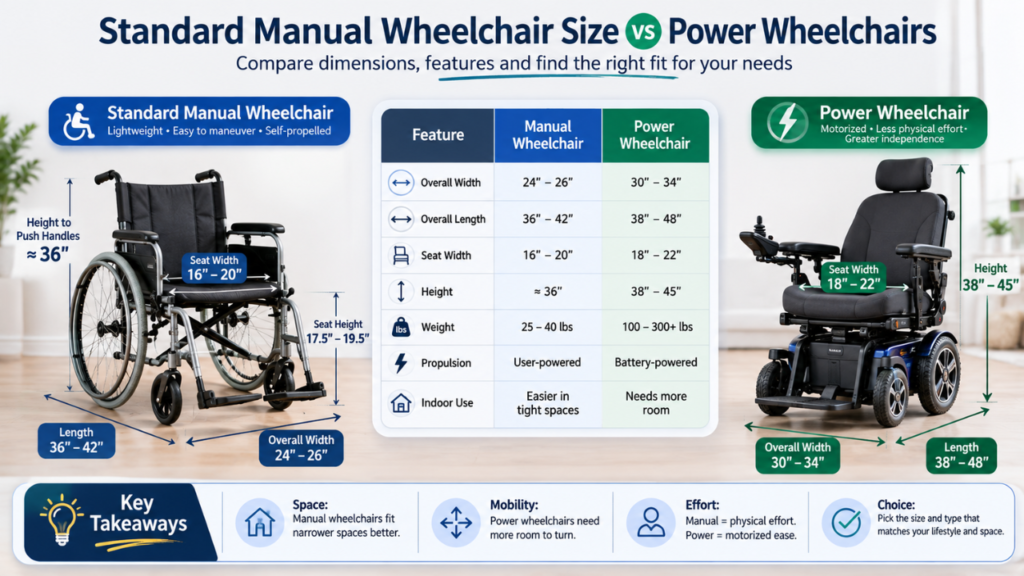
Most of the standard wheelchair sizes referenced are with manual wheelchairs, whilst power wheelchairs generally run larger due to the presence of extra components such as a battery, motor, and control.
| Measurement | Manual Standard Wheelchair Size | Power Wheelchair Size |
| Overall width | 24-26 inches | 30-34 inches |
| Overall length | 36-42 inches | 42-48 inches |
| Seat height | 17.5-19.5 inches | 19-20 inches |
Due to the size of many power wheelchairs exceeding standard wheelchair size dimensions, spaces considered appropriate for a power chair often require additional width in doorways and space for manoeuvre than that required by baseline manual wheelchair standards.
Pediatric and Bariatric Variations
Most of this guide is about the standard adult wheelchair size, but it might be worth mentioning that we have different categories for wheelchairs designed for children or larger-bodied adults. Or, pediatric wheelchairs, their complete widths are usually less than 24 inches, which can be reduced to proportions in the overall real scale on a more compact body. In contrast, a bariatric wheelchair is wider and heavier-duty than even the largest standard-size wheelchairs, usually with seat widths that are 30 inches or larger in addition to being able to handle much higher weight capacities.
ADA Guidelines Referencing Standard Wheelchair Size
In the USA, the Americans with Disabilities Act (ADA) mandates accessibility requirements for several public buildings and includes many specifications that revolve around standard wheelchair size dimensions. These dimensions are used to calculate minimum doorway clearances, hallway widths, and turning spaces so that no one will be left out of public areas because most wheelchairs don’t meet the smallest possible limits.
This is why knowing about standard wheelchair size even matters for non-wheelchair users. Established figures that architects, business owners, and facility managers rely on to ensure their spaces are following the letter of the law as to accessibility while meeting real-world needs of those who will use them.
How to Pick the Right Fit
When deciding upon a wheelchair for either you or somebody else, remembering several handy hints will help your way in the world of standard overall size wheelchairs.
- Measure the user, not just another space. Seat width and depth must be determined from precise measurement of a person’s body instead of estimates.
- Account for cushions. A seat cushion can increase the height of the seat a small amount, and the position of leg rests and footrests should take this into account.
- Check doorway widths at home. Before you think a standard wheelchair will fit comfortably throughout the entire home, measure your narrowest interior doorway.
- Consider long-term needs. If the need for wheeling back or weight, or mobility is likely to vary, it might be better opting for a bit more tradeable if possible & wider option in the first instance.
- Consult a professional when possible. Occupational therapists and mobility equipment specialists can be instrumental in making sure the dimensions selected actually meet what the user needs instead of going off generic standard wheelchair size charts.
Also Read: Pokemon Card Dimensions | Badminton Court Dimensions
Final Thoughts
The answer to this question is much more complex than simply a single number. These specifications, in combination, determine whether a wheelchair, and the space around it will actually facilitate comfortable, safe mobility: from overall footprint and seat dimensions to doorway clearances and turning-space requirements. These standard numbers make it much easier to understand the whole process, whether you’re purchasing a chair, designing an accessible renovation or simply trying to navigate your way around principles of accessibility.
Frequently Asked Questions
1. How wide and deep is a standard adult manual wheelchair?
A standard manual wheelchair measures approximately 24-26 inches wide and 36-42 inches long.
2. What is the typical seat width for a wheelchair?
Such as the 18 inch seat width is the standard.
3. Is a standard wheelchair going through a doorway?
Yes. The majority fit through doorways measuring 30-32 inches in width.
4. What is the turning space needed for a wheelchair?
This has a recommended turning space of 60 inches.
5. How will I know if I need a different wheel chair size?
If standard sizes don’t match your body metrics, consider a wheelchair that is either bariatric, pediatric or custom.