
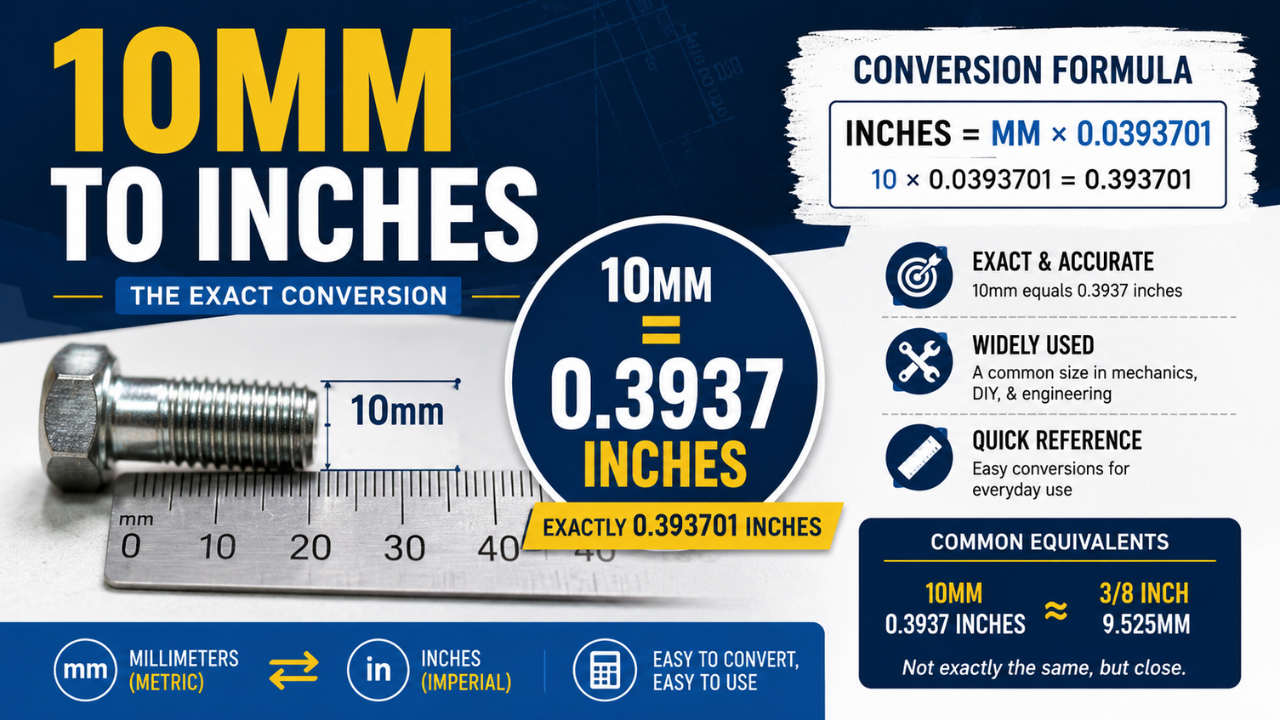
Be it reaching for the right wrench under your car hood, deciphering a hardware label or finding some semblance of understanding with an international product measurement, 10mm to inches is just one of those little practical and useful things we actually wish to know. The truth is, you are guided through the conversion itself, then we explain the hang of the math that makes it happen and provide a handful of comparisons to help that number actually register when relatable.
Quick Answer: 10mm to Inches
10mm is about 0.3937 in. For everyday use, it usually works out to 0.39 inches round or approximately 25/64 of an inch when you express it as a fraction.
The 10mm to Inches Roller Coaster Conversion
Once you understand the underlying math, converting any similar measurement becomes a simple task without requiring your calculator every time. The factor for converting to inches is that one millimetre equals 0.0393701 of an inch; therefore, to convert millimetres into inches, simply multiply the millimetre figure by this conversion ratio.
To take the example measurement here: 10 multiplied by 0.0393701, this gives you the answer of 0.393701 inches. It’s 0.39 inches if you round that number up to two decimal places, which is good enough for nearly any day-to-day use where precision isn’t as important, like whether your hardware will physically fit or comparing product dimensions.
Quick Conversion Table
| Millimeters | Inches |
| 5 | 0.1969 in |
| 8 | 0.3150 in |
| 9 | 0.3543 in |
| 10 | 0.3937 in |
| 11 | 0.4331 in |
| 12 | 0.4724 in |
| 15 | 0.5906 in |
Having this table handy makes it very simple to get a sense of how this measure stacks up against numbers just above or below and is often helpful in identifying which tool, nut, bolt etc. measurement (by sight) will most likely be the right size for use.
Reasons Why Users Keep Searching 10mm to Inches
There is a pragmatic reason this specific conversion comes up all the time, in particular for those who work with tools, hardware, or globalised products.
In automotive and mechanical work, 10 mm is the most commonly used size for socket or wrench sizes on bolts, nuts, and fasteners worldwide through common mechanized parts in existence. If you work on a car, bicycle, or piece of furniture assembled using metric hardware, then you make this conversion all the time to see if your imperial toolset has a close enough match, as there is no exact-fitting inch socket.
It’s important for anyone who is working on a project with mixed measurement systems for millimeter-to-inch conversion, especially among international products in hardware and construction where screws, drill bits, and fasteners are regularly labeled in millimeters.
It sounds a bit awkward, but it is quite useful in manufacturing and engineering where exact tolerances often involve the conversion of metric to imperial units and vice versa; also, this number happens to be fairly common as it falls in a range that is used for small components, spacers, and fittings.
However, retailers from overseas commonly denote the sizes in millimeters – while anyone used to inches needs a way to assess precisely how large or small an item really is before deciding to buy.
Also Read: 100 Inches | 2 Inch | 3 Meters | 7 cm
Real-World Comparisons for 10mm to Inches
Just numbers do not always present the whole picture, and therefore it is reasonable to relate this metric against some physical references.
Measuring 0.39 in, it is comparable to the diameter of a pencil, or roughly the thickness of four credit cards stacked together. It’s also roughly the size of a standard wooden matchstick, really helping you feel how small this measurement is in actual physical reality.
Especially for those of you who work with tools, a 10mm socket is practically the size of a 3/8-inch socket, but not quite, which is why mechanics tend to have both metric and imperial socket sets in their shops instead of relying on one operating system being able to fully code for the other. It is also the reason why bolt heads and fastener sizes are usually stamped directly on the hardware, as bounding approximately between the two systems can easily catch you in a place where you grab the wrong tool.
Mistakes That People Make When Converting 10mm to Inches
When people do this conversion manually, a couple of little mistakes tend to come up over and over. A very frequent error is to assume 10mm rounds off neatly to a common imperial fraction, i.e., 8 mm is often incorrectly placed at the embarkment of roughly three-eighths of an inch, when three-eighths of an inch = 9.525 mm, which is unmistakably more expansive than 10mm converted or approximated = 0.3937 inches. That tiny gap is why using a slightly wrong-size socket can, over time, gradually strip a bolt or fitting.
A common error that can occur when quickly reading a product label is mistaking millimetres for centimetres because 1 cm is in fact equal to 10mm; as such the same 0.3937 inch conversion would have applied however, the original label used an entirely different metric unit.
10mm to Inches in Different Contexts
| Context | Why the Conversion Matters |
| Automotive repair | Selecting the correct socket or wrench size for metric bolts |
| Furniture assembly | Understanding screw and fastener sizes on imported furniture |
| Jewelry and small parts | Converting bead, gemstone, or component sizes accurately |
| 3D printing and prototyping | Ensuring designed dimensions match physical tolerances |
| Online shopping | Comparing product dimensions from international retailers |
How to Convert 10mm to Inches – The Quickest Method without a Calculator
No calculator at hand? If you just need a rough, very quick mental shortcut, it generally works rather okay even for casual needs. Given that one inch is approximately 25.4mm, using a simple millimeter number divided by 25 can give an approximate value at this stage. Divide 10 by 25, and you get a nice clean 0.4, which is very close to the actual number of inches in mm – only a .0063 inch difference, or about one-two hundredth the thickness of human hair. While this hack won’t make you machine-shop-spec, it’s a very useful way to quickly get the conversion on critical-path items when all you need is a ballpark figure.
Why it Gives Precision more Importance with Smaller Measurements
Whereas with larger conversions, the tiny rounding errors hardly matter, this conversion is a good example of how precision goes hand in hand with shrinking measurements. It is because at this scale, a rounding error of even one tenth of a millimeter can indicate a meaningful percentage difference, which is why manufacturing tolerances, engineering specifications, and precision tools are based on exact figures as opposed to ballpark approximations. In most cases, it suffices to round 0.39 inches against socket sizes or minimum wall thicknesses of plastic components, but when tight-fitting parts get involved, and you go for construction tolerances or engineering specifications, the full figure will have to be used (0.3937 inch, or even a more accurate decimal).
Conversions for 10mm to Inches and Related Conversions
There are times when a millimeter-to-inch conversion isn’t enough, especially if you are working on an interconnected project with a few dimensions at once. As in the case when you are building imported furniture, and you need to convert multiple hardware measurements at once: length of screws, thickness of the panel, etc., basically everything that comes with new hardware coming from Asia is listed in millimetres on the instruction manual.
Likewise, even someone doing a home improvement project that involves mixing metric and imperial materials, like putting in European-made fixtures in a home constructed to standard American measurements, usually has to convert several figures back and forth multiple times throughout the same job. This familiarity with millimeter-to-inch conversions over a general set of values, not just this one measurement, makes traversing these mixed-unit circumstances much easier.
Today, digital tools and smartphone apps make these kinds of conversions nearly instantaneous, but knowing and understanding the underlying math is still genuinely useful when you find yourself in a situation devoid of internet access, or if you simply want to ensure that an app or calculator has given you a correct result. Mechanics and hobbyists still keep a printed conversion chart in their toolbox or workshop for this very reason; quick access to straightforward information without needing to dig through the phone saves a lot of real time with hands on a project.
Also Read: Stairs Dimensions | What Weighs 40kg | 3 Ounces
Conclusion
If you are picking the right tool for a repair job, looking at product dimensions from an overseas retailer or a helping hand with precision engineering specification, knowing how to convert this unit measure quickly and accurately is genuinely useful. This will simply convert a measurement from meters to inches or the other way around, 0.3937 inches specifically is pretty easy, and you’ll be able to use this simple multiplication method for almost any similar measurements you will encounter going forward. This way you have both the rough ballpark number and the number needed for a more precise estimate, depending on whether you need to make an educated guess or hit an exact match.
FAQs About 10mm to Inches
1. What is 10mm in inches?
10mm = 0.3937 inches (approximately).
2. How to convert 10 mm to inches?
0.0393701 × 10= 0.3937-inches
3. Is 10mm the same as 3/8 inch?
3/8 inch = 9.525mm so it’s slightly smaller than 10mm
4. How could you quickly estimate 10mm in inches?
Yes. If you are in a hurry, divide 10 by 25 to arrive at around 0.4 inches.
5. Does rounding affect the conversion?
Yes. The value is the same, but the result differs due to rounding.